I recently had an exchange on Twitter with Martin Crowe, an Irish dairy farmer and agri-consultant, over the apparent stagnation in Irish agricultural output over the past 20 years (follow on @xAlan_Matthews and @martincrowe). I attributed this, in part, to the role that direct payments play in Irish farm incomes. I argued that “If 70% of your income is coming as a cheque in post there is less incentive to innovate to grow the remaining 30%” (direct payments make up around 70% of Irish farm income in an average year). Martin tweeted back that the “70% gives the security and confidence to try and improve the 30%”.
At issue here is the impact of CAP direct payments on farm productivity. As the Twitter exchange indicates, there are potentially both positive and negative effects.
How direct payments might affect productivity
In the agricultural economics literature, the positive effects rely on credit constraints and assumptions about risk behaviour in agriculture.… Read the rest
How MEPs voted on CAP reform
The website VoteWatch Europe monitors the voting of MEPs on each resolution and piece of legislation. It published the following commentary on the CAP reform voting earlier this month (thanks to Xavier Pavard @xpavard on Twitter for drawing attention to this source) which I reproduce here.
(Note: Right click on the images below and select Show picture to get clearer view of the graphics)
… Read the restCentre-right wins battle over CAP reform; net contributor country MEPs outvoted
MEPs voted on a package of four legislative proposals that make up the reform of the Common Agricultural Policy (CAP). The subject was hotly debated, as CAP currently accounts for close to 40% of the EU budget. CAP is to be reformed with effect from 1 January 2014. To ensure better targeting of aid, the proposal gives Member States the responsibility for defining what constitutes an “active farmer”.
Other provisions are that no Member State’s farmers should receive less than 65% of the EU average, that young farmers should get a 25% top-up payment for a maximum of 100 ha and that direct payments to any one farm should be capped at €300,000.
Evolution of the direct payments regulation
In January I prepared a spreadsheet setting out the amendments to the Commission’s proposed direct payments regulation which took account of the COMAGRI rapporteur’s amendments May 2012, the Council’s position as summarised in the Cyprus Presidency document December 2012 and the COMAGRI compromise amendments Jan 2013.
Some readers found this useful so I have now updated the spreadsheet to take account of the COMAGRI proposal for a negotiating mandate in February 2013 (that is, after COMAGRI voted on the compromise and other amendments), the mandate following the European Parliament plenary vote in March 2013, and the successive versions of the regulation prepared by the Irish Presidency for the March 2013 Agricultural Council meeting. The updated spreadsheet can be downloaded here (use the download arrow in the top left corner when the Google Drive document opens to download the spreadsheet to your computer).
The Irish Presidency prepared three versions of Council’s general approach on the direct payments regulation.… Read the rest
Are we really moving forward?
The debate on the future of the CAP has recently moved on with two important steps – the European Parliament plenary vote and the European Council agreement. Just to take up the story, the European Parliament Plenary voted in Strasbourg on 13 March on the over 330 amendments COMAGRI made this year to the European Commission’s official communication on the CP reform in October 2011. This was the first time in history when the Parliament could use her co-decision powers, affecting European Council decisions. This all happened, of course, after the deal reached on long-term budget on February 8, the consequences of which are well summarised in the interview with Paolo de Castro, Chair of COMAGRI at the European Parliament (see the video made by Vi(eu)ws here).
The Plenary vote mainly favoured the Commission’s original ideas against the various amendments. Consequently, Dacian Ciolos, the European commissioner for agriculture, welcomed this fact and said that it was an important step in the CAP reform process (see full reaction here).… Read the rest
Implications of the new redistributive payment
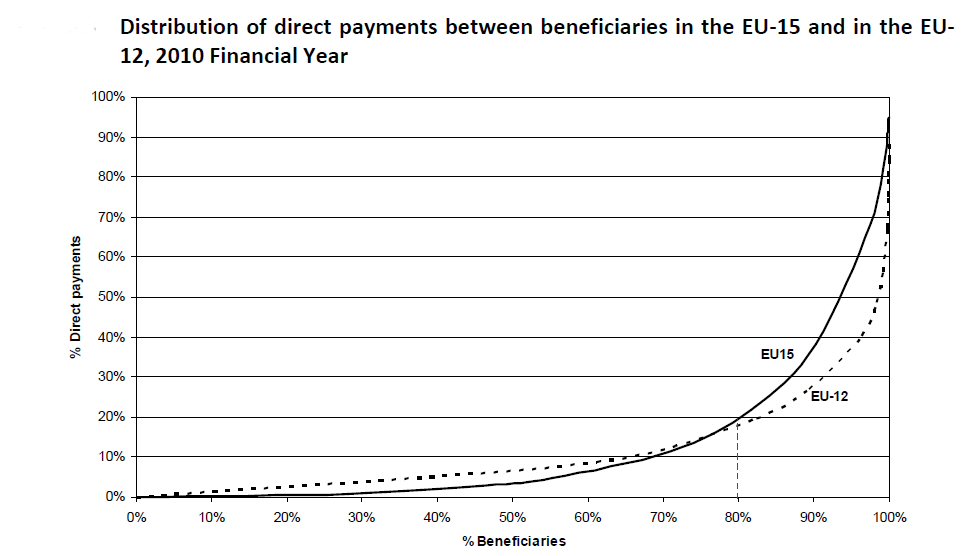
Ever since direct payments were introduced into the CAP, their unequal distribution has attracted unfavourable attention. The Commission’s 1991 paper The Development and Future of the CAP criticised the distribution of price support, noting that “80% of the support provided by FEOGA is devoted to 20% of farms which account also for the greater part of the land used in agriculture”. Yet the proportions remain exactly the same in both the EU-15 and EU-12 today, according to the Commission’s latest figures for the claim year 2009 (financial year 2010) (see diagram).
Even for those who argue that the specific nature of farming justifies a permanent system of direct payments support, the unequal distribution of support is hard to justify. The Commission has regularly made proposals to reduce payments to larger farms through either progressive modulation and/or capping. But these proposals equally regularly were either watered down or rejected by the member states.… Read the rest
The biodiversity consequences of killing Ecological Focus Areas
After the December 2012 Council proposed amendments, the vote of the agricultural committee of the European Parliament (COMAGRI) on January 24 2013 de facto kills any hope of deriving serious biodiversity benefit from the CAP reform. The COMAGRI amendments are particularly fatal to the Ecological Focus Area (EFA) measure, which is now nearly ‘as dead as a dodo’. The fact that the COMAGRI amendments largely restate the Agricultural Council’s draft position on the EFA leaves little hope for future debates between the Parliament and the Council. The conclusions of the European Council on February 8, 2013 can be seen as the burial of the EFA.
Many economists and think tanks doubted that the combination of Pillar 1 payments and green requirements was the most cost-efficient way to promote biodiversity and were not enthusiastic about the EFA idea. It is now time for them to realize that while Pillar 2 payments will be cut, Pillar 1 payments will be maintained but without any serious biodiversity requirement.… Read the rest
Promoting innovation through the EIP Agricultural Productivity and Sustainability
Last week I attended a meeting of the High Level Steering Board of the European Innovation Partnership for Agricultural Productivity and Sustainability (EIP-A) representing the European Association for Agricultural Economists. The meeting was jointly organised by Dacian Ciolos, Commissioner for Agriculture and Rural Development, and Maire Geoghegan-Quinn, Commissioner for Research and Innovation.
It brought together 42 people representing member states, the farm and food sectors, NGOs, representatives from existing Joint Programming Initiatives in the food and agriculture area as well as scientific associations and the university sector. The purpose of the meeting was to provide input for drawing up the EIP Strategic Implementation Plan (SIP) and the agenda was organised around four questions relating to priorities, bottlenecks, mobilising farmers and delivery mechanisms and funding.
Given the diversity of interests around the table, the discussion highlighted inevitable tensions around (a) the concept of innovation and how to define it (b) the balance between agricultural and food innovation particularly in the context of the EU’s bioeconomy strategy, and (c) within agriculture, the emphasis to be given to increasing production with less external inputs compared to more agroecological approaches placing more emphasis on sustainability and less on production.… Read the rest
Paolo De Castro on the CAP Reform Process
Rose O’Donovan, editor of the excellent Agra-Facts, has interviewed Paolo De Castro, CAP reform veteran and currently holding a key role as Chairman of the European Parliament’s agriculture committee. Worth a watch.
… Read the rest
Implications of the European Council MFF agreement for the agricultural environment
This is a shortened version of a post which was first written for the Institute for International and European Affairs EnvironmentNexus blog
From the perspective of the agricultural environment, there are three elements in the European Council conclusions on the EU’s Multi-annual Financial Framework on 7-8 February which should be noted.
The first element is the general commitment that climate action objectives will represent at least 20% of EU spending in the period 2014-2020 and should be reflected in the appropriate instruments to ensure that they contribute to strengthening energy security and building a low-carbon, resource efficient and climate resilient economy.
As agricultural spending will continue to account for 36% of total MFF spending during this period, it will also have to contribute to this objective. This will require a classification of what spending contributes to climate action objectives. One might speculate, for example, that the Commission is likely to consider the proposed green payment in Pillar 1 as a climate action instrument, in addition to some spending under the Pillar 2 rural development budget.… Read the rest
What the proposed MFF has for agriculture?
Herman Van Rompuy, President of the European Council introduced the acceptance of the new MFF yesterday on his Twitter page by writing that
Deal done! The European Council has agreed on MFF for the rest of the decade. Worth waiting for.
Although this is not the final agreement as the European Parliament still has to confirm the Council decision, it is highly unlikely that the EP risks the hard-fought agreement reached at the Council. Therefore, the playing arena for agriculture in the next seven years is set in the final conclusions published by the Council.
In general, the deal reached limits the maximum possible expenditure for a European Union of 28 Member States (with Croatia’s accession this year) to €960 billion in commitments, corresponding to 1.0% of the EU’s GNI. This means that the overall expenditure ceiling has been reduced by 3.4% in real terms, compared to the current MFF – the first time in history when such a reduction is made.… Read the rest