Financing emergency aid to address market disruption due to COVID-19

There has been strong pressure on Commissioner Wojciechowski to get the Commission to do more to protect farmers and agricultural markets from the adverse effects of the lock-down responses to the coronavirus pandemic.

The Commissioner has argued that there is no funding available for these measures in the EU budget. In this post, I assess the funding that may be available to the Commissioner. I conclude that available funding is limited but not exhausted. It now seems time to make use of the crisis reserve that was put in place for exactly this eventuality as well as unused margins under the European Agricultural Guarantee Fund (EAGF) in the EU budget.

The EU budget is a very complex entity, and it is not easy for an outsider to have a complete understanding of how it works. There may well be errors in the following account, and if so, I would be grateful to have them pointed out. The exercise is still valuable as context for any future debate on crisis management in the CAP as part of the ongoing negotiations on the future CAP framework post 2020.

Growing demand for EU intervention

Copa-Cogeca has highlighted the market breakdown for livestock producers in the dairy, beef, sheep and goat sectors and called for additional targeted market measures for the livestock sector, including exceptional measures, financed outside the CAP budget. Specifically, it has called for the activation of private storage measures for dairy products and the different meats, as well as more targeted management of Tariff Rate Quotas for imports.

Copa-Cogeca has also highlighted problems in the ornamental sector and for some fruits and vegetables. Also the wine market, where exports had already been hit by US tariffs of 25% imposed as part of US retaliation against Airbus subsidies, has been further affected by the loss of sales of higher-quality wines as restaurants remain shuttered.

The European Milk Board has called for a voluntary supply reduction programme in the dairy sector covering a few months in which producers would be compensated, similar to that introduced at the time of the last milk price crisis in 2016. The French dairy sector representative group CNIEL has already introduced a €10 million solidarity fund under EU rules to compensate suppliers who agree to reduce production.

According to Euractiv, MEPs in the European Parliament’s Agriculture Committee have also written to the Commissioner calling on the Commission to use the emergency instruments in the common market organisation (CMO) “as soon as possible”. The Committee is looking for intervention measures as well as opening private storage. In addition, it supports the activation of the crisis reserve which has been financed by withholding a proportion of the direct payments paid to farmers at the end of 2019 and which if left unused would be returned to them as part of their direct payment paid out at the end of this year. Some MEPs have called for a compulsory volume reduction in the dairy sector to avoid milk storage or destruction as the spring peak in milk production approaches.

Ministers of Agriculture have also supported these calls. In a letter initiated by Ireland and sent to the Commissioner on 16 April, all EU agriculture ministers, while welcoming the measures taken in the European response to date, called for urgent additional measures to be taken under the CAP, including aid for private storage to support those sectors where significant price impacts have been identified, as well as exceptional aid to farmers in the most affected sectors.

Commissioner Wojciechowski, when addressing the Parliament’s AGRI Committee on 15 April, accepted that requests for market intervention measures were legitimate but pointed to the absence of money in the EU budget to finance such measures. “These are legitimate expectations and if the Commission had a sackful of money it would dip into it straight away”, the Commissioner is reported as telling MEPs. However, he added that there is no such sack in the current financial framework, as there was no reason to do so when adopting the budget last year.

The Commission has announced two sets of measures so far to help the agri-food sector in its response to the pandemic. On 25 March, DG AGRI announced an extension of the deadline for submitting CAP payment applications, as well as details of additional flexibilities for Member States to provide aid to farmers and food processing companies under the newly adopted Temporary Framework for State Aid (especially paragraph 23 in that Framework).

A further set of measures were announced by DG AGRI on 2 April. These included the possibility to reallocate unused funds within Rural Development Programmes to finance relevant actions to face the crisis, an increase in the advance payment of direct payments farmers will receive after mid-October and rural development payments, plus a reduction in the number of physical on-the-spot checks to ensure eligibility conditions are met.

Whether market intervention measures are justified or not is always a judgement. Agricultural market prices are anyway volatile, and normal market risk is something that should be left to producers and processors to manage. However, some agricultural sub-sectors have experienced an exceptional drop in demand where taxpayer assistance can be justified. Market intervention can also be justified to provide some market stability when there is a sudden and temporary drop in prices.

State aid measures will remain the most important response

Following the changes made in the 2013 CAP reform to the crisis management measures available under the Common Market Organisation (CMO) Regulation, the CAP has the policy flexibility to respond to market disruption but not necessarily the budget. This reflects the relatively inflexible structure of the EU budget more than any ceiling on available funds per se.

The EU cannot borrow to finance a sudden increase in the demand for resources such as can result from an agricultural market crisis. Especially for an EU-wide crisis that affects all agricultural sectors, the EU budget will never be able to cope on its own. It is also relevant to recall that, under the Treaties, agriculture is a shared competence between the Union and the Member States. It is thus reasonable to expect Member State initiatives to play a role, perhaps even the major role, in providing income assistance to farmers where this is justified.

This is the rationale behind the Temporary Framework for State Aid Measures introduced in response to the COVID-19 outbreak in March. As the Commission noted when bringing forward this measure: “Given the limited size of the EU budget, the main response will come from Member States’ national budgets”. Under the Temporary Framework, Member States have the possibility to provide up to €100,000 per farm in state aid following rapid approval by the Commission, provided the aid is not fixed on the basis of the price or quantity of products put on the market. In addition, Member States can top up this amount by de minimis aid with a ceiling of €20,000 per farm which does not require Commission approval.

To get a sense of the potential scale of this assistance, if we multiply €120,000 per farm by the approximately 6.5 million beneficiaries of EU direct payments, then the theoretical total pot of money available in the EU for farm income support is €780 billion if Member States decide there is a need to activate it. Clearly, we will never come anywhere near this theoretical maximum but it is helpful to be reminded of the firepower that is available.

Member States have already begun to use this option. DG COMP, the Competition Policy Directorate-General, maintains a webpage with a weekly e-News update which gives details of all decisions approving state aid. Most decisions refer to economy-wide support and it would require further work to identify to what extent farmers will benefit from the assistance provided. But it is up to national governments to decide on those sectors they deem to be in greatest need of support.

EU budget financing for market measures

Member States, however, cannot undertake market intervention which is reserved to the Union. Thus it is also important to assess the Commissioner’s claim that there is no money in the kitty to finance such measures.  There are four potential sources of EU revenue:

  • The crisis reserve
  • Appropriations-in-aid
  • Margin below the ceiling in Heading 2 of the MFF
  • Special flexibility instruments.

We now look closer at each of these options.

The crisis reserve. The EU budget no longer contains specific amounts for crisis spending for export refunds or intervention. Instead, there is a crisis reserve made up by withholding a portion of direct payments (€478 million withheld from 2019 payments that should be reimbursed to farmers after October 2020). The Commissioner has argued against using this because it is farmers’ own money that they rely on during the crisis. As we have seen, the EP’s COMAGRI believes it should be used.

There are three arguments in favour of the Committee’s position. The first is that using the money now means it can aid farmers in the next few months when it is needed, rather than waiting until after the middle of October to disburse these cheques. Second, using the reserve as it was intended to provide crisis assistance would allow the money to be targeted to those sectors in greatest need. Not all agricultural sectors have experienced an adverse shock to the same extent, for example, pigmeat prices are up 40% on a year earlier because of the impact of African swine fever on Chinese herds. Third, reimbursing the crisis reserve to farmers in October is a form of income support, whereas the crisis reserve can also be used for market intervention which, by managing supply to prevent prices from falling further, could have a multiplier effect on income.

Appropriations-in-aid. During the financial year, there are often exceptional and unexpected appropriations-in-aid that provide additional resources to the CAP budget over and above what is appropriated through the budget process. Commissioner Hogan was able to use significant revenue from milk superlevy fines to support the milk market in the 2016 price crisis. It is too early in the financial year to know whether there will be an unexpected surge in such receipts this year, but it is hard to see why this might occur. On this front, Commissioner Wojciechowski will not be so lucky as Commissioner Hogan.

MFF margins. The ceilings established in the Multi-annual Financial Framework (MFF) for specific headings and sub-headings represent the maximum level of authorised commitment appropriations under these headings as well as overall annual payments. The annual budgets rarely use all of these ceilings, and the difference represents a margin of unused expenditure.

The second Draft Amending Budget to the 2020 General Budget providing emergency support to Member States to respond to the COVID-19 outbreak proposed by the Commission on 2 April gives an updated table of current margins under commitment appropriations by MFF Heading. The unused margin for Heading 2 Sustainable Growth: Natural Resources (which includes the CAP) is shown as €514 million whlie the margin for the EAGF sub-heading (covering direct payments and market expenditure) is shown as €477 million – almost exactly the same figure as in the crisis reserve. It only requires the agreement of the budgetary authority (the Council and Parliament) to make use of this margin, no revision of the MFF ceilings (which would require unanimity in the Council) is required.

There is also a flexibility instrument in the budget called the Global Margin for Commitments (GMC). This allows the Commission to propose the re-deployment of margins left available in precedent years to subsequent years. Originally, these funds could only be used to finance actions related with growth and employment. In 2016, this was extended to migration and security issues. The Commission has now proposed an amendment to the MFF regulation so eliminate all scope restrictions to the use of the GMC in the current financial year. However, at the same time, it has proposed to deploy all of this funding (around €2 billion) to finance the Emergency Support Instrument intended to help Member States address the COVID-19 outbreak. Therefore, no funds are available under this instrument for agricultural market price support.

Special flexibility instruments. The need to increase the EU’s ability to respond to unforeseen events at the time when the MFF was agreed has led over time to the creation of a number of special flexibility tools that allow the financing of specified expenditure that cannot be financed within the limits of the ceilings available for one or more MFF headings (this briefing from Magdalena Sapala of the European Parliamentary Research Service gives an excellent overview).

The Flexibility Instrument specifically provides funding for clearly defined expenditure that cannot be covered by the EU budget without exceeding the maximum annual amount of expenditure set out in the MFF. However, its funding in 2020 has been fully exhausted to support measures to manage the migration, refugee and security crisis. Thus, there is no possibility of recourse here to fund unanticipated agricultural market expenditure.

Relaxing environmental measures is not an appropriate response

This review of the options available to support those farmers who have been particularly badly hit by the economic fall-out from the coronavirus pandemic highlights, first, the crucial role of national measures. The Commission has indicated its willingness to approve very substantial amounts of State aid if Member States request it. This is up to individual member states. There will be significant differences both in the ability of individual countries to fund such assistance packages as well as differences in the relative severity to which different economic sectors have been affected (for example, the tourism and hospitality sectors have borne the brunt of employment losses in many countries).

At the same time, it appears there may still be some funding available in the EU budget, consisting of the crisis reserve as well as the unused margin under the EAGF sub-heading in the MFF, that could be used to provide some targeted market support. However, the total amount is limited to around €950 million, with half of this made up of the crisis reserve that farmers would expect to receive after October in any case. The Commissioner’s declaration that his hands are tied by a lack of EU budget resources is thus partly justified, although there are some steps that can be taken.

At the same time, we are hearing calls from various groups (for example, the EPP group in the European Parliament or the Farm Europe think tank) calling for the postponement of planned initiatives necessary to address increased climate ambition and to promote more sustainable farming that are expected to be announced in the Farm to Fork Strategy as part of the European Green Deal, now delayed to the end of the summer. Indeed, there are worrying indications that some national administrations may be willing to relax existing conditionalities that farmers should observe to be eligible for payments, for example, with respect to Ecological Focus Area requirements.

Following this advice would both be a false economy as well as result in shifting the costs of responding to the crisis to the environment just at the time when we are realising more and more the value of environmental services to society. Improving soil health, restoring biodiversity habitats, protecting water quality, tackling water depletion, addressing air quality and reducing greenhouse gas emissions were all urgent environmental challenges before the coronavirus pandemic and they are no less urgent after it.

As thirteen environment and climate ministers from around Europe wrote in a joint letter emphasising that the European Green Deal must be central to a resilient recovery from the COVID-19 outbreak: “The lesson from the Covid-19 crisis is that early action is essential. Therefore, we need to maintain ambition in order to mitigate the risks and costs of inaction from climate change and biodiversity losses”.

Update 22 April 2020: The day following the publication of this post, DG AGRI announced a third package to assist the agricultural sector including measures for private storage aid (PSA) in the dairy and meat sectors, the authorisation of self-organisation market measures by operators in hard hit sectors and flexibility in fruits and vegetables, wine and some other market support programmes. The details of their financing are not yet available but it seems some additional funding has been found within the CAP budget.

This post was written by Alan Matthews

Photo credit: Downloaded from pxhere.com, used under CC0.

U.S. farm support to explode in election year 2020

The U.S. has agreed on a $2 trillion stimulus package, the largest economic stimulus in its history, in response to the economic impacts of Covid-19. U.S. farm groups lobbied hard to be included in the package, and $23.5 billion was included in the final package for farm aid. This farm aid comes on top of the two trade aid packages of $12 billion and $16 billion introduced by the Trump Administration in 2018 and 2019, respectively, to provide relief to commodity producers hurt by the retaliatory tariffs introduced by various countries in response to tariffs on their exports to the U.S. introduced by President Trump.

Assuming no change in market prices and other farm income in 2020 compared to the February 2020 USDA farm income forecast, if all of this emergency aid were paid out in 2020, then 40% of U.S. farm income in 2020 will derive from government payments. While not all of the emergency aid may be paid out in calendar year 2020, it is also likely that counter-cyclical payments will increase and other farm income will also fall compared to the February 2020 forecast in response to falling export and home demand. This means the projection that around 40% of all U.S. farm income this year will derive from government support is probably not far off the mark. This would be unprecedented in recent U.S. history, but would still mean that the share of government support in the U.S. is below the level in the EU.

The CARES Act

President Trump signed the Coronavirus Aid, Relief, and Economic Security Act, also known as the CARES Act, into law on 30 March 2020. The original bill introduced by the Senate Majority Leader Mitch McConnell would have provided around $1 trillion in aid. By the time bipartisan negotiations had concluded, the amount of aid provided had increased to $2 trillion, around 10% of US GDP. The act is much larger than the $831 billion stimulus act passed in 2009 as part of the response to the Great Recession.

These proposals follow an initial $8.3 billion measure passed in early March to boost Covid-19-related emergency funding, as well as the Families First Coronavirus Response Act (FFCRA) that provided funding for free coronavirus testing (though treatment still came at a cost), 14-day paid leave for American workers affected by the pandemic, and increased funding for food stamps.

The main provisions of the CARES act have been widely reported though there are different estimates for some of the amounts in the package (see also here). The most innovative feature is around $250 billion in ‘helicopter money’ to American families below a specified income threshold who will receive checks of up to $1,200 per person (plus $500 for children under 16) through the tax system (it is estimated around 94% of Americans will be eligible). A further $250 billion will go to bolster unemployment insurance. There is $350 billion in loans for small businesses that may be forgiven if firms use them to keep workers on payroll. $500 billion in aid is made available for hard-hit large corporations and $50 billion for airlines. Hospitals get $130 billion in aid to cover the cost of treating uninsured workers, while there is $340 billion to help state and local governments cover budgetary shortfalls as tax income plummets.

Farm aid in the CARES Act

As late as February this year, in the wake of the partial trade deal between the U.S. and China under which China committed to increase purchases of U.S. agricultural exports, the Secretary for Agriculture Sonny Perdue was advising farmers not to count on receiving additional payments for trade disruption in 2020. He envisaged the end of the Market Facilitation Program that had provided farm income support in the two trade aid packages in 2018 and 2019.

Mind you, the very next day President Trump tweeted that if farmers needed more aid while waiting for the terms of various trade deals to kick in, that money would be made available from the tariff revenue generated on imports into the U.S.. As it has turned out, the stimulus for additional aid has not been trade on this occasion, but the consequences of the coronavirus pandemic.

There are two main elements in the farm aid package in the CARES Act. The first is $9.5 billion in emergency aid that is made available to the Secretary for Agriculture to provide “support for agricultural producers impacted by coronavirus, including producers of specialty crops, producers that supply local food systems, including farmers markets, restaurants, and schools, and livestock producers, including dairy producers”. The second element is $14 billion for the Commodity Credit Corporation (CCC) that can fund farm income, price support and conservation programmes. In addition, the USDA will also receive an additional $25.1 billion for food aid programmes for poor families under the stimulus bill.

The congressional legislation gives the Secretary for Agriculture broad discretion on how to distribute this aid to farmers. The precise way in which aid will be provided has yet to be decided, with Secretary for Agriculture Sonny Perdue saying further details will be given later this week. Under the Market Facilitation Programme, which was the principal way the trade aid was distributed in 2018 and 2019, most of the money went to row crop producers although there was a broader range of beneficiaries in the 2019 package.  Commentators expect that the CCC funding tranche will probably follow similar guidelines, but the $9.5 billion emergency aid element specifically mentions producers of speciality crops, producers that supply local food systems as well as livestock and dairy farmers.

Impact on direct budgetary support for U.S. farmers

The pattern of U.S. government support in the form of direct payments to farmers in recent years is shown in the following chart. The figures are shown in nominal dollars, despite the misleading legend included in the chart, as is confirmed in the notes to the chart.

The U.S. ended decoupled direct payments in the 2014 Farm Bill and moved instead to counter-cyclical payments. In addition, conservation payments as well as ad hoc and emergency aid payments make up a significant chunk of farm support. For a description of the U.S. farm safety net after the 2014 Farm Bill, see my 2016 post, although further changes were introduced in the 2018 Farm Bill. The Market Facilitation Program is particularly important in 2019 where it includes a significant element of the 2018 Program payments that were paid in the 2019 calendar year. The chart does not include the subsidies paid by the government for crop insurance.

Source:  Congressional Research Service, U.S. Farm Income Outlook: November 2019 forecast, Report R46132, December 2019.
Notes: Data are on a calendar-year basis and reflect the timing of the actual payment. Although the chart states that the figures are in inflation-adjusted 2019 dollars, this is not the case and the source in the original notes that all values are in nominal terms. “Direct Payments” include production flexibility contract payments enacted under the 1996 farm bill and fixed direct payments of the 2002 and 2008 farm bills. “Price-Contingent” outlays include loan deficiency payments, marketing loan gains, counter-cyclical payments, Average Crop Revenue Election, Price Loss Coverage, and Agricultural Risk Coverage payments. “Conservation” outlays include Conservation Reserve Program payments along with other conservation program outlays. “Ad Hoc and Emergency” includes emergency supplemental crop and livestock disaster payments and market loss assistance payments for relief of low commodity prices. “All Other” outlays include cotton ginning cost-share, biomass crop assistance program, peanut quota buyout, milk income loss, tobacco transition, and other miscellaneous payments.

The next chart shows the importance of U.S. government support to farmers relative to net farm income. This chart is updated to 2020 based on the first USDA forecast of 2020 farm income made on 5 February 2020 (thus after the announcement of the U.S.-China partial trade deal and the outbreak of coronavirus in China and just after the first cases had been announced in Italy, but before the severity of the economic consequences of the measures needed to slow the spread of the disease had become apparent). This chart has been converted to inflation-adjusted 2020 US dollars and includes crop insurance subsidies as well as direct payments to farmers.

Source:  Own derivation based on USDA Farm Income and Wealth Statistics, February 5 2020 forecast, https://data.ers.usda.gov/reports.aspx?ID=17830.
Note: Covid-19 emergency aid package of $23.5 billion has been added assuming no change in other government payments or other farm income.

For the purpose of illustrating the impact of the CARES Act farm aid package, I have simply added it to the farm aid and other farm income amounts as projected by the USDA in early February. If these projections remain valid, then total farm support would amount to about 40% of U.S. farm income this year. However, as for the 2018 and 2019 Market Facilitation Program payments, some of the 2020 payments would probably be made in the 2021 calendar year.

On the other hand, the aid package has been driven by concerns about falling prices and falling incomes as a result of the covid-19 outbreak. This would result in lower total farm income than shown in the chart. Lower prices and incomes would trigger higher payments also under the U.S. counter-cyclical programmes. The final outcome could thus be greater support and lower total farm income than shown in the chart, thus pushing the share of support even higher than the 40% estimated here.

Update 17 April 2020: The U.S. Secretary for Agriculture today announced details of the immediate emergency package. This will amount to $19 billion direct assistance to farmers, made up of the $9.5 billion emergency aid package under the CARES Act plus a further $6.5 billion in CCC funding using its existing credit line authority. The further $14 billion made available in the CARES Act for the CCC will not become available until July and is thus held in reserve. Secretary Purdue has indicated that there will almost certainly be more aid announced in the coming months which the CCC funding can be used to finance. Additional details on how the package will be divided are included in this press release from the Chair of the Senate Agricultural Appropriations Committee John Hoeven. For further background, see this briefing from agricultural economists at the University of Illinois.

This post was written by Alan Matthews

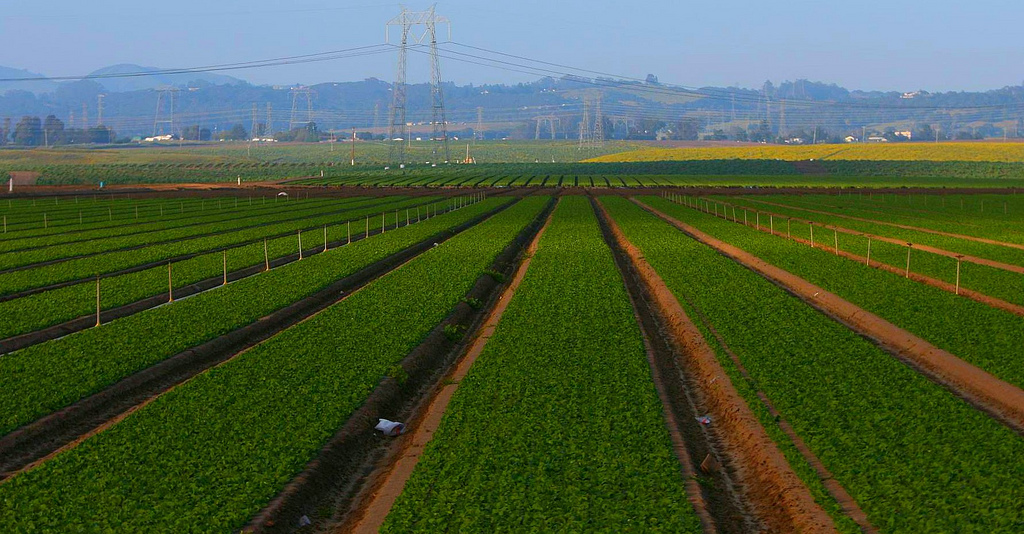
Photo credit: Monterey County irrigation by Richard Masoner, used under (CC BY-SA 2.0) licence

Coronavirus uncertainty as CAP decisions are postponed

There is increasing focus on how the coronavirus pandemic is likely to affect agricultural markets, food supply chains and farm incomes (for example, the series of IFPRI Resources and Analyses on COVID-19). Panic buying of long-life staples – as well as toilet roll, of course – led to temporary shortages on supermarket shelves but supplies were very quickly replenished.

In the medium-term, there are concerns that labour shortages, logistical difficulties in transporting goods across borders and falling export demand have the potential to cause disruption. The various actors in the European food chain issued a statement on 19 March calling attention to likely operational difficulties and asking the Commission to ensure that free movement of goods within the single market can continue, including through managing ‘green lanes’ at borders, to allow the food chain to function effectively.

The European Milk Board has called on the Commission to start preparing the launch of a voluntary milk supply reduction scheme as it expects processing capacity will not be sufficient to handle the volume of milk farmers are able to produce.

Any or all of these initiatives would require policymakers to respond. The question how policymaking can continue with stringent social distancing restrictions in place has thus become more urgent. In this post, we look not at the short-term responses to the potential for disruption but rather at the implications of the COVID-19 pandemic for ongoing negotiations affecting the future of the CAP. The most important of these is the need to agree on the EU long-term budget, the Multi-annual Financial Framework (MFF), for the 2021-2017 period.

The 2021-2027 MFF

The extraordinary meeting of the European Council called to discuss the MFF in February failed to reach agreement with positions between the net contributor Member States and the net recipient Member States far apart. Farmers are aware that the CAP budget included as part of the package put on the table for that meeting represented a 3% reduction in nominal terms compared to CAP spending in the current MFF period.

Another meeting of the European Council should have taken place later this week which might have provided another opportunity for discussion. However, this European Council meeting has been postponed and will be replaced by a videoconference where only responses to the coronavirus pandemic will be discussed.

The MFF negotiations are important not only because they establish the ceiling for CAP support in the medium term, they also determine the value of payments that farmers will receive later this year. This is because direct payments to farmers in 2020 are financed from the 2021 EU budget due to the way the EU budget works.

When the MFF negotiations resume, they will take place in a vastly different economic context. The fall in economic output this year could rival that of the Great Financial Recession in 2008, depending on how long the economic lockdown continues.

Such a negative economic shock will require a major injection of public funds to overcome. Already, we are seeing European governments respond to the crisis with astronomical compensation packages for businesses and workers. One estimate is that countries such as Germany, the UK and Denmark have already announced stimulus packages (or what some economists are calling shield packages) amounting to 15% of their GDP. In the context of the enormous sums now being mobilised at very short notice to minimise the adverse effects of the restrictions necessary to address the pandemic, the amounts at stake in the MFF negotiations are puny.

Whether these compensation packages will encourage Member States to look more favourably on increased EU spending including the CAP budget, or whether they will constrain their ability to finance such spending, is not yet clear. It will depend, in part, on the depth and persistence of the economic collapse and on how farm incomes are affected relative to other workers in the economy including the self-employed.

There is still time to reach an MFF agreement before the end of this year but Member States may be reluctant to resume serious negotiations until the economic fallout from the coronavirus pandemic is clearer.

If no agreement is reached, the EU Treaties provide that there is an automatic and temporary extension of the ceilings in the last year of the current MFF. Paradoxically, this would result in a significantly higher MFF volume (around 1.15% of EU GNI) compared to the 1.11% proposed by the Commission and the 1.074% proposed by the European Council President prior to its February 2020 meeting.

However, as the MFF co-rapporteurs in the European Parliament’s Budget Committee have pointed out in a draft own-initiative resolution, having money available to spend does not help if there is no legal authority to use this money. Many expenditure programmes contain expiry dates that have to be prolonged to avoid a shutdown of the concerned programmes and to protect the beneficiaries. Their draft resolution calls on the Commission to propose legislation by 15 June 2020 that would extend the time limits laid down in the basic acts of all concerned expenditure programmes and to update the relevant financial amounts on the basis of technical prolongation of the 2020 MFF ceilings.

The CAP transition regulation

As it happens, such a transition regulation was already proposed by the Commission in October 2019 to cover the CAP. This was not because of the delays in the MFF at the time, but in the light of the slow pace of negotiations on the CAP reform package proposed by the Commission in 2018. This slow pace was due to disruptions caused by the Brexit negotiations, elections to the European Parliament in the middle of 2019, as well as the failure until now to agree a budget framework for the coming period. All of this meant that the deadline for submission of national CAP Strategic Plans for approval by the Commission by 1 January 2020 could not be met.

The idea behind the transition regulation is that existing rules would continue to apply for at least one more year within the framework of the budget ceiling given by the new MFF. Member States that have already used up their funds avaliable for the 2014-2020 period will be able to finance these extended programmes from the corresponding budget allocation for the year 2021. They will be expected to maintain at least the same overall environmental and climate ambition when prolonging their schemes. Member States that still have funds available are given the option to transfer their 2021 budget to the 2022-2027 period if they wish.

The Parliament’s AGRI Committee had intended to provide its opinion on this draft regulation in April with a vote scheduled in the whole Parliament in June which would allow negotiations to open with the Council of Agriculture Ministers. The position of the Council is not yet finalised and its working documents with proposed amendments are not available to the public. However, decisions should be made by mid-2020 to allow Member States to make the necessary adaptations at national level.

Many are of the view that it would make sense to extend the transition regulation for a two-year period given this uncertainty. In the COMAGRI rapporteur Elsi Katainen’s draft report, the Commission’s draft regulation is amended to extend the transition period to two years if MFF conclusions for the period 2021-2027 are not published in the Official Journal by the end of September. I suspect this amendment will be supported by the Committee and by the Parliament in plenary and will also find support in the Council. Given the delays and difficulties in finalising the MFF, a two-year transition must now be the most likely outcome.

The CAP budget for direct payments in 2020

The transition regulation also sets out the national envelopes for Member States for 2021 for both direct payments and rural development spending. Because the MFF was not concluded when the Commission prepared the draft regulation, it entered figures based on the overall ceilings for Pillar 1 and Pillar 2 spending contained in its own MFF proposal from May 2018. While this proposal foresees a relatively small reduction in spending on Pillar 1 direct payments in nominal terms, it included a significant reduction in Pillar 2 spending on rural development.

The COMAGRI rapporteur argues that, if farmers should work to the same rules in 2020 as in 2019, they should also work for the same money. She has proposed that the national allocations included in the Annexes to the transition regulation should be calculated on the basis of the figures agreed for the MFF 2021-2027 or, if not adopted in time, on the basis of extended 2020 ceilings in accordance with the Treaty provisions.

In case this results in a sharp cut in Pillar 2 ceilings in 2021, the rapporteur suggests allowing Member States to increase their national co-financing to allow rural development programmes to continue without any cuts to farmers.

When discussing the roll-over arrangements for the MFF ceilings in the event of no MFF agreement being concluded before the 2021 EU budget is adopted, I highlighted that the 2020 ceilings for the various headings and sub-headings, including the CAP, would automatically be carried forward to 2021. In principle, therefore, it would be possible to continue to make direct payments to farmers at the same level in 2020 as in 2019.

Whether this would happen in practice would depend on the outcome of the EU’s 2021 budget negotiations later this year, where decisions in the Council are taken by qualified majority and the Parliament has equal status as co-legislator. It could therefore be quite late into this year before farmers know the value of their direct payments.

Farm to Fork Strategy

Another argument for a longer transition period is that it would allow more time to absorb the implications of the Farm to Fork Strategy which is the agri-food component of the European Green Deal and to integrate its objectives into the CAP Strategic Plans.

The Strategy was originally expected to be announced this week but this has now also been postponed by at least one month. It is expected to contain high-level targets for reduced use of fertilisers, pesticides and antibiotics, an expansion in organic farming while also highlighting the more ambitious targets to reduce net greenhouse gas emissions and incentivising carbon sequestration practices.

Finding a way to properly debate these potentially far-reaching proposals if the social distancing measures to address the coronavirus pandemic remain in place will be a challenge. At a purely banal level, EU rules of procedure to allow decisions to be taken by videoconference rather than requiring a quorum at physical meetings will be necessary.

Conclusions

In summary, policymaking in the coronavirus era will have to adapt until population immunity is built up and a vaccine is available. A way will be found to make farm direct payments in 2020 but the level of these payments may not be known until much later this year.

The delays in decision-making mean that any new CAP rules under the CAP Strategic Plans will be postponed most likely now for two years.  To the extent that the new CAP framework would have facilitated a greater emphasis on addressing urgent environmental and climate challenges, this delay is unfortunate.

These challenges do not simply disappear because of the coronavirus. This makes it all the more important to use the additional time as productively as possible to see how best to integrate the recommendations of the Farm to Fork Strategy into Member States’ CAP Strategic Plans. As the European Court of Auditors notes in its Opinion on the transition regulation: “This additional time should be used to address the climate and environmental challenges set out in the Green Deal, ensure robust governance of the future CAP and shore up its performance framework“. I agree totally.

This post was written by Alan Matthews.

Update 12 May 2020: The description of the options available to Member States with respect to their rural development programmes has been corrected.