The anti-EU agitprop outfit Open Europe has been huffing and puffing over the golden goodbyes that await those European Commissioners who will be put out to pasture when the current Commission’s five year mandate comes to an end later this year. Among their number is thought to be our own Agriculture Commissioner, Mariann Fischer Boel who, after five years of service in Brussels stands to receive approximately 270,000 euros of ‘transition money’ before her 43,000 euro a year pension kicks in.
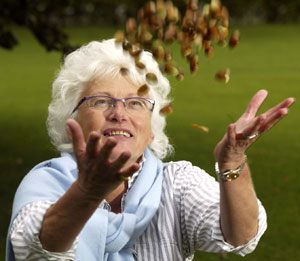 The 66-year old Dane, who sports a trademark shock of snow white hair, has invoked the spirit of Hollywood actress Jennifer Aniston in the L’Oréal commercials, insisting the payout is entirely justifiable “because I’m worth it”. It’s just as well that the Commission scheme is so generous since Fischer Boel, who together with her husband owns several large livestock farms, is too old to qualify for the EU-funded early retirement scheme for farmers, which pays out a maximum of €18,000 a year to farmers who quit before turning 55.… Read the rest
Fischer Boel golden goodbye: “Because I’m worth it”
The anti-EU agitprop outfit Open Europe has been huffing and puffing over the golden goodbyes that await those European Commissioners who will be put out to pasture when the current Commission’s five year mandate comes to an end later this year. Among their number is thought to be our own Agriculture Commissioner, Mariann Fischer Boel who, after five years of service in Brussels stands to receive approximately 270,000 euros of ‘transition money’ before her 43,000 euro a year pension kicks in.
The 66-year old Dane, who sports a trademark shock of snow white hair, has invoked the spirit of Hollywood actress Jennifer Aniston in the L’Oréal commercials, insisting the payout is entirely justifiable “because I’m worth it”. It’s just as well that the Commission scheme is so generous since Fischer Boel, who together with her husband owns several large livestock farms, is too old to qualify for the EU-funded early retirement scheme for farmers, which pays out a maximum of €18,000 a year to farmers who quit before turning 55.… Read the rest
Why CAP reform happened
The latest Journal of Common Market Studies (vol.47, 2, March 2009) contains an important article exploring the determinants of CAP reform. It is written by Alan Swinbank, a distinguished agricultural economist and a leading proponent of reform and Arlindo Cunha who was chair of the Agriculture Council in 1992 at the time of the MacSharry reform.… Read the rest
UK Tories on a crooked path to protectionism?
I realise that opposition politicians have to say all things to all persons and jump on any bandgwagon that’s going on, but I must say that I found an interview with Nick Herbert, the shadow Defra secretary, in Farmers Weekly a bit disappointing. It remains to be seen whether the MP for Arundel and South Downs will be Defra secretary in David Cameron’s Conservative government, or even whether Defra will remain in his present form. However, if his thinking is typical of that in the shadow cabinet on agriculture and food matters, it’s a bit worrying. It looks as if we could be lurching back towards productionism.… Read the rest
Tenant farmer tells it like it is
I have a lot of sympathy with tenant farmers. It is sometimes said that farmers are asset rich but income poor, by which it is meant that they own a lot of extremely valuable land but don’t make a whole lot of profit from working it. In the case of tenant farmers, who have to rent their land, they are too often asset poor and income poor.
The UK Tenant Farmers Association recently held its annual jamboree and, fresh back from his half term holiday in Egypt, National Chairman Greg Bliss gave a speech. He used the occasion to share some observations about agriculture policy that I thought might be of interest to readers of this blog. For those who are not familiar with a dialect known as ‘farm union leaderese’ (which is rare, though it can be found all over Europe and North America) I have provided translations of the key passages.… Read the rest
Don’t watch this, take a look at that
You will be forgiven for wondering why things have been a little on the quiet side here at CAPHealthCheck.eu over the past couple of months. For my part, besides some intensive behind-the-scenes work at farmsubsidy.org and and exciting new EU budget transparency project that’s still under wraps, I’ve been blogging more on the EU budget than on the CAP, mostly over at FollowTheMoney.eu. Among the other leading contributors to this website, Wyn Grant has been on a fact-finding visit to Australia and Alan Matthews has been attending to his teaching responsibilities as well as working away on his forthcoming magnum opus on the CAP and global development. Fear not, we will be back in the saddle soon enough, but while things are running at a little below full capacity, you might want to take a look over at an excellent new website/blog called CAP2020: Debating the future of the Common Agricultural Policy.… Read the rest
Don't watch this, take a look at that
You will be forgiven for wondering why things have been a little on the quiet side here at CAPHealthCheck.eu over the past couple of months. For my part, besides some intensive behind-the-scenes work at farmsubsidy.org and and exciting new EU budget transparency project that’s still under wraps, I’ve been blogging more on the EU budget than on the CAP, mostly over at FollowTheMoney.eu. Among the other leading contributors to this website, Wyn Grant has been on a fact-finding visit to Australia and Alan Matthews has been attending to his teaching responsibilities as well as working away on his forthcoming magnum opus on the CAP and global development. Fear not, we will be back in the saddle soon enough, but while things are running at a little below full capacity, you might want to take a look over at an excellent new website/blog called CAP2020: Debating the future of the Common Agricultural Policy.… Read the rest
10 reasons why the Single Payment Scheme is politically unsustainable (part two)
Last week I posted five reasons why it is hard to justify spending 30 billion euros each year on the Single Payment Scheme. Here are five more reasons. … Read the rest
10 reasons why the Single Payment Scheme is politically unsustainable
The EU spends around 30 billion euros each year on the single payment scheme, by far the largest of the myriad schemes and programmes that together comprise the 54 billion euro budget of the Common Agriculture Policy. The scheme was first introduced in 2005 but it is hard to see it surviving in its current form beyond the end of the EU’s 2007-13 financial perspective. Here are five reasons why the single payment scheme is not politically sustainable. Five more will follow tomorrow.… Read the rest
Budget pressure on CAP
With the Health Check out of the way, it looks as if the medium-term future of the CAP is going to be strongly influenced by discussions of how the EU budget should be spent. This always raises the awkward question of the opportunity cost of spending large sums of money on subsidising farmers.… Read the rest