Informal meeting Agricultural Ministers in Sweden 14-15 September to discuss agriculture and climate change

The Swedes have chosen to highlight agriculture and climate change at the informal agricultural council meeting next week. The discussion will be built around three questions:

1. Climate change is of great concern for the future competitiveness of EU agriculture and this challenge is being dealt with at all levels. While the framework is set at EU level, implementation will need to be carried out at farm level.

What should be the role of the EU regarding mitigation and adaptation in agriculture, and, in particular, what should be the key areas of cooperation?

2. An instrument in handling climate change in the agricultural sector is rural development programmes. While climate change is already one of the Community priorities for the current programming period, additional funds were provided that can be targeted to climate relevant actions.

How are these opportunities best utilised and are there any early lessons to be learned?

3.

Read the rest

Is EU agriculture carbon-efficient?

A relatively new argument being used to justify support for agricultural production in the EU is that reductions in EU food production would be made up by increases elsewhere where less efficient production systems exist and thus would result in a heavier carbon footprint. This raises the question whether this statement is factually correct and what do we know about the relative carbon efficiency of production systems in different parts of the world?… Read the rest

UK House of Lords reviews 2010 EU draft budget

In a recent report, the UK House of Lords European Committee criticised the European Commission’s proposals for the 2010 European Communities budget for maintaining a very high level of spending on agriculture, and failing to shift adequate resources to stimulus measures to aid economic recovery. It expressed frustration that, in the middle of an economic crisis, the proportion of the budget going to agriculture remained so large.

It identified a particular problem for the funding of the second tranche of the European Economic Recovery Programme. This was the stimulus package of €5 billion agreed in March 2009, of which €2.6 billion was to be funded from the 2009 budget and €2.4 billion from the 2010 budget. Because of the limited margin between the Financial Perspective ceiling and proposed appropriations for Heading 1 of the budget Sustainable Growth, last year it was agreed to fund the energy infrastructure projects by transferring some of the unused margin under Heading 2 (mainly agriculture) to Heading 1.… Read the rest

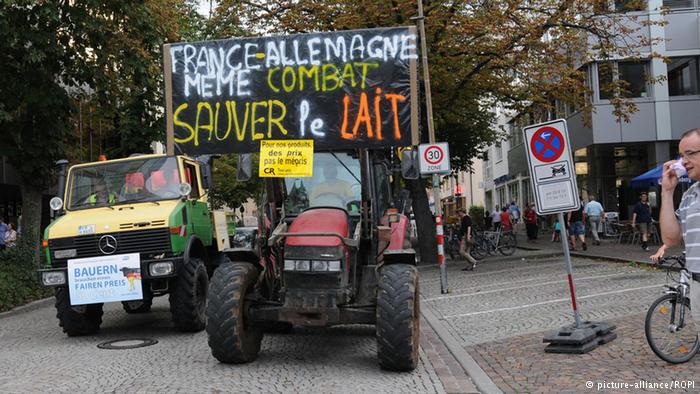
Addressing the dairy crisis – is US intervention buying a good thing for EU producers?

Today, the US raised its intervention support prices for some dairy products as a way of supporting the US farm price for milk. The support price for skimmed milk powder was increased by 15 percent and for cheddar cheese by 16 per cent for a limited 3-month period. Immediately milk prices on the Chicago Mercentile Exchange increased by 5 per cent, and it is estimated that the measure will add $243 million to US dairy farm incomes in the current year.

From a European perspective, this measure has ambiguous effects and may even be welcomed for its short-run effects. In the short run, the Commodity Credit Corporation will enter the market as an additional buyer, raising the floor price of milk. While only US milk products are eligible for support, as a major dairy exporter this action is going to help to strengthen world market prices, to the benefit also of EU producers.… Read the rest

Where to find data on EU export refunds?

Recently, I was looking for an internet source for EU export refunds – not overall expenditure, but the refund rates for individual commodities by month. What I was hoping to find was an Excel worksheet which set out this information, but it seems extraordinarily hard to come by. The nearest I could get was the excellent webpage on export refunds for milk and meat products maintained by OFIVAL, the French marketing agency. However, the data here take the form of pdf files containing the information every time the refund levels are changed, and it would be extremely tedious to transfer this into an Excel file. Another excellent site is Datum, hosted by the UK Dairyco. Here the information on export refunds for dairy products is updated weekly, and it is also possible to download an Excel file with historical data, but of course the data only covers dairy. The Commission’s CIRCA network also seems to have pdf versions of export refunds – you can view the sugar data here – but access to CIRCA more generally and to its interest groups requires one to register so I don’t know if similar information for other CAP commodities is also available here.… Read the rest

Latest WTO agriculture update

Pascal Lamy, the WTO Director-General, provided an end-of-term report on the status of the Doha Round trade negotiations at the July meeting of the Trade Negotiations Committee before delegates left for their August break. This is what he had to say about the agricultural negotiations.

As you know, work in agriculture is continuing, particularly in light of the renewed political mandate from the G20 and G8. The Revision 4 bracketed and annotated areas needing further work have been identified. These include SSM [Special Safeguard Mechanism] (especially the architecture), cotton, issues related to sensitive products, preference erosion and tropical products, TRQ [Tariff Rate Quota] expansion as well as tariff simplification. The Chair has indicated that consultations are underway to determine how best to broach these issues, with a view to a steady programme of technical work in late-summer through to the autumn. The aim is to complete as much as possible of the outstanding technical work so as to set the stage for decisions on more political issues.

Read the rest

Does farm size influence environmental outcomes?

A widely-accepted justification for subsidising agriculture is that we need to prevent the emergence of the industrialised, mono-cultural agriculture which is the inevitable result of an efficiency-based, cost-oriented farming model by protecting the diversified, environmentally-friendly small farmer in order to maintain the positive environmental benefits of European agriculture. This is part of the philosophy of agrarianism which underpins much discussion of agricultural policy.

Let us leave aside for the moment the fact that the bulk of existing farm subsidies go to larger farmers rather than smaller ones, so that even if the thesis above is valid, current agricultural policy does not support it. My interest is in the evidence for the thesis itself. Is it the case that small farms are better for the environment?… Read the rest

Trends on the EU rice market

There was a fundamental reform of the EU rice market in 2003. The intervention price was cut in half to bring it down to the (then) level of the world prices, and producers were compensated by an increase in direct payments. An important impetus for this reform lay in the market opening offer by the EU to least developed countries (LDCs) under the Everything But Arms agreement which promised duty-free and quota-free access for rice imports from LDCs from September 2009.

Few LDCs are net exporters of rice. However, it was feared that LDCs might export, in line with the rules of origin, the totality of their domestic rice production to the EU, while importing their domestic consumption requirements from the world market. Another fear was that the LDCs might import raw rice, process it and then export it back to the EU, adding sufficient value so as to meet the rules of origin requirements.… Read the rest

The 2006 EU sugar reform in review

Two interesting papers on EU sugar policy recently crossed my desk. One is an account of the ‘new’ sugar regime after the 2006 reform by three legal academics from the University of Barcelona, in which they also examine whether the reformed regime is likely to be compatible with any agreement from the Doha Round negotiations. The other is the one of the series of regular reports by the US Foreign Agricultural Service on EU agricultural markets, this time on the likely impact of the EU sugar reform on ACP (African, Caribbean and Pacific) and LDC (least developed country) sugar exporters. … Read the rest