


For this post, I have used OpenAI’s GPT-5.3 model, May 2026 to help with identifying sources, summarising material, and drafting. The use of large language models in academic and policy-oriented writing remains contested, particularly where issues of authorship, reliability, and originality arise. I have used the model as a research aid rather than a substitute for judgement. Sources identified through the model have been independently checked, and the text has been revised to reflect my own interpretation and emphasis. The purpose of this blog is also partly heuristic: writing serves to organise my own thinking, with the model functioning as a tool in that process. Readers who prefer not to engage with material developed in this way may reasonably choose to look elsewhere, but I hope that the curation, verification, and synthesis undertaken here provide value beyond what a generic model output would deliver. As always, feel free to add your comments to let me know your views on this.
News media reports in the past week (see Politico here and Financial Times (subscription required) here) reported on new proposals to accelerate Ukraine’s integration into the EU following the informal dinner in early March 2026 involving EU ambassadors and Commission officials which decisively dismissed Commission thinking on possible “reverse enlargement”. However, as the Financial Times headline noted: “Officials are none the wiser about how to bring Kyiv into the bloc”. The European Council in its conclusions on Ukraine adopted following its informal meeting in Cyprus on 19 March invited the Council to open the negotiating clusters with Ukraine without delay, but neither Hungary nor Slovakia endorsed these conclusions.
The new proposals, put forward separately by Germany and France, would offer a form of associate membership to Ukraine (or, in the French proposal, ‘integrated state status’). They mark a distinct break from the revised accession methodology introduced in the Commission Communication Enhancing the accession process – A credible EU perspective for the Western Balkans in February 2020 at a time when Ukraine (and Moldova) were not considered candidate countries. The key dilemma the proposals address is how to give Ukraine a credible prospect of accession while recognising that the EU has not yet done its homework on how new members can be integrated into the existing acquis.
In this post, I discuss the reasons for the greater urgency around Ukrainian accession, review the revised enlargement methodology introduced in 2020, describe what we know about the French and German proposals and Ukraine’s reaction, and place these proposals in the context of the status of enlargement negotiations with other candidate countries. While most attention is focused on whether the EU can agree on the outlines of its Multi-annual Financial Framework by the end of this year, these accession issues may prove at least as difficult for the Union to resolve as the budget negotiations.
Ukraine’s path to EU accession
The first phase of Ukraine’s path to EU membership opened abruptly in the aftermath of the Russian invasion of Ukraine. Within days, Ukraine submitted its application for EU membership (28 February 2022). The political response from the Union was unusually rapid. At the European Council meeting in Brussels on 23–24 June 2022, heads of state and government granted Ukraine candidate status. At that point, enlargement was framed explicitly as a geopolitical instrument. The decision was taken with full awareness that Ukraine was far from meeting accession criteria, but the political signal was considered paramount.
A second phase, extending through 2023 and into 2024, was characterised by technical preparation combined with political blockage. The Commission proceeded with the analytical screening of the acquis, a process largely completed by mid-2024. Under normal circumstances, this would have been followed by a decision to open formal negotiations. However, this step was effectively stalled. Opposition from Viktor Orbán, together with more cautious positions from several other Member States, prevented agreement in the Council to open negotiations on the various clusters. Enlargement remained on the agenda, but without forward movement.
The third phase begins toward the end of 2025, when the issue regained political momentum. Part of this renewed attention appears linked to a possible US-backed peace initiative, in which Ukraine’s EU accession was framed as part of a broader settlement architecture. At the same time, the tone of the Ukrainian position also changed. President Volodymyr Zelenskyy began to articulate a much more explicit and compressed timetable, repeatedly referring in late 2025 to 2027 as a target date for accession. These statements were made in multiple fora, including interventions at European Council meetings and public addresses to EU audiences. While the date was widely viewed in Brussels as aspirational rather than realistic, it had the effect of imposing a time horizon on what had previously been an open-ended process. As a result of the efforts of the Danish Presidency, informal technical work on the six negotiating clusters began and have continued under the Cyprus Presidency.
The response from the Commission in early 2026 has been twofold. On the one hand, in statements in Brussels in January and February 2026, Enlargement Commissioner Marta Kos emphasised that the accession process could be accelerated through more efficient handling of negotiations, such as clustering chapters and allowing parallel progress, without relaxing substantive conditions. On the other hand, the policy debate briefly broadened following the circulation in Brussels policy circles of an informal Commission “non-paper” suggesting elements of what came to be described as “reverse enlargement”. The idea, never formally adopted and subsequently set aside, was that Ukraine could be granted an intermediate, quasi-membership status early in the process which would allow participation in EU institutions and selected policy domains, but full alignment with the acquis and access to core budgetary instruments would follow only over time. Its rapid disappearance from the agenda underlines the political sensitivity of modifying existing policy frameworks.
Finally, developments within the Union itself have altered the political constraints on moving forward. The electoral defeat of Viktor Orbán in early 2026 removed one of the most visible sources of resistance to opening negotiations. While unanimity requirements still give other Member States scope to slow the process, the disappearance of a consistent veto player has changed expectations in Brussels. Even so, the change in political dynamics does not resolve the core constraints, as concerns about the budgetary implications of Ukraine’s accession and the institutional adjustments it would require remain firmly in place.
The accession methodology
The accession methodology applied to Ukraine builds on earlier practice but has been progressively modified in response to perceived weaknesses in previous enlargements. The baseline remains the framework established at the Copenhagen European Council. The so-called Copenhagen criteria set three core conditions for accession: stable democratic institutions and rule of law, a functioning market economy capable of withstanding competitive pressure within the Union, and the ability to adopt and implement the acquis communautaire.
In the enlargements of 2004, 2007 and 2013, these criteria were operationalised through a chapter-by-chapter negotiation process, with progress measured largely in terms of formal transposition of EU law. The sequencing was, in practice, relatively technocratic. While political conditionality was present, it was unevenly enforced, and once a country acceded, the Union had limited instruments to address backsliding. This experience, particularly with respect to rule-of-law developments in some Member States after accession, has shaped subsequent reforms of the methodology.
A first significant revision came when the Council endorsed the Commission’s 2020 communication, Enhancing the accession process – A credible EU perspective for the Western Balkans. This introduced a more explicitly “merit-based” and politically steered process. In formal terms, negotiations are now organised into six thematic clusters (fundamentals; internal market; competitiveness and inclusive growth; green agenda and sustainable connectivity; resources, agriculture and cohesion; external relations). The “fundamentals” cluster covering rule of law, public administration, and economic governance is opened first and closed last. Progress in other clusters is conditional on credible performance in this area. This creates a form of sequencing that is both stricter and more reversible than before. The 2020 approach introduced the possibility of “reversibility”, meaning that negotiations in a given area can be paused or even rolled back if there is evidence of backsliding. Each intermediate step in this process is subject to unanimity in the Council.
The debate around Ukraine has pushed beyond these incremental adjustments and briefly opened a more structural line of thinking about how enlargement might proceed. The informal “reverse enlargement” proposal or, in some accounts, a “membership first” model, that circulated in Brussels in late 2025 would have inverted the traditional sequencing. Instead of requiring full prior alignment with the acquis, Ukraine would have been granted a form of early or partial membership status, with full compliance and institutional adjustment following over time.
In practical terms, this could have implied immediate political inclusion in EU institutions, alongside phased alignment with core policies such as the internal market, the Common Agricultural Policy, and cohesion policy. It is precisely here that opposition emerged. For many Member States, particularly those concerned about the budgetary implications for cohesion policy and the Common Agricultural Policy, such an approach risked triggering redistribution before the candidate had met established conditions. Others raised legal concerns about the compatibility of partial membership with the treaty framework.
The Kos approach
The more recent position articulated by Enlargement Commissioner Marta Kos can be understood as an attempt to accelerate the process without reopening these distributive questions. Three elements can be distinguished.
First, there is an emphasis on procedural efficiency within the existing framework. This includes wider use of cluster-based negotiations, parallel opening of chapters within clusters, and streamlined screening procedures. The objective is to shorten timelines without altering the substantive conditions for accession.
Second, the Commission has stressed the strengthening of safeguards against post-accession backsliding. While the principle of reversibility already exists in the negotiation phase, the current discussion points toward more durable mechanisms that would extend, in some form, beyond accession. This reflects lessons drawn from earlier enlargements, where enforcement tools weakened significantly once membership was granted. Commissioner Kos has referred to a “new generation” of accession treaties in this respect.
Third, there is increasing use of performance-based integration and funding. Candidates can obtain earlier access to specific EU programmes, funding instruments, or elements of the internal market, conditional on measurable progress in defined areas. This is sometimes described as “phased integration”. It differs from “reverse enlargement” in an important respect. Under phased integration, the acquis and EU policies remain unchanged; the candidate is gradually incorporated into them as it meets the required conditions. Under “reverse enlargement”, by contrast, the need to accommodate a quasi-member would most likely be met through transitional regimes, differentiated access, or temporary exclusions from budgetary instruments. A principal distinction is around the sequencing and allocation of rights, which is also central to the French and German association proposals.
The French and German association proposals
The German position, as reported in the media coverage cited previously, centres on the idea of an “associate member” status that would allow Ukraine to participate in EU institutions without full decision-making rights. In practical terms, this would involve representation in the Council (participation in ministerial meetings) and in the European Parliament, but without voting rights. There has also been discussion of a Ukrainian presence in the European Commission in the form of an “associate” Commissioner, again without formal powers. Substantively, Ukraine would be aligned early with EU foreign and security policy and would be progressively integrated into elements of the single market and selected EU programmes. However, access to the EU budget, and particularly the large redistributive instruments such as the Common Agricultural Policy and cohesion policy, would be deferred until full membership. The German framing places emphasis on political inclusion and signalling, while containing the immediate budgetary implications.
The French approach overlaps with this logic but is framed somewhat differently. References to an “integrated state” status point toward a model of partial membership in which Ukraine would be embedded in core EU policy processes without being a full member state. As with the German proposal, participation in institutions would not be accompanied by voting rights, and access to major spending programmes would be postponed. The emphasis here is less on creating a distinct legal category of “associate membership” and more on a gradual deepening of integration across policy domains, combined with symbolic recognition of Ukraine’s European status.
The fact that the proposals have only been reported in the media in the past week means that, at least for outsiders, much of the detail remains to be filled in. It will now be up to the Commission to come up with formal proposals that may try to flesh out the German and French ideas. Across both approaches, there are shared commonalities. First, early and visible political integration, including participation in institutional forums. Second, gradual economic integration, particularly into the single market and sectoral policies. Third, a clear deferral of full budgetary participation and voting rights until accession is complete. In that sense, these proposals can be seen as an attempt to separate the political and economic dimensions of membership from its fiscal consequences.
Ukraine’s reaction makes clear that it fears proposals for “associate membership” or some other partial membership status would become a substitute for, rather than a stage towards, full membership, reinforcing concerns about a “permanent waiting room”. Speaking with reporters on his way to the informal Council meeting in Cyprus last month, President Zelenskyy rejected the idea of partial EU membership for Ukraine, saying “Ukraine does not need symbolic membership in the EU. Ukraine is defending itself and is definitely defending Europe. And it is not defending Europe symbolically – people are really dying.” Instead, Zelenskyy has doubled down on his insistence on a concrete and accelerated accession timeline, specifically asking for the opening of negotiations on all six negotiation clusters before the end of June.
Ukraine’s approach makes legal sense, in that it follows the agreed path for accession albeit demanding a much accelerated timeline. The EU treaties do not currently provide for partial membership of the kind apparently envisaged in the French and German proposals, and any durable version of “associate membership” would likely require either treaty change or reliance on ad hoc arrangements outside the formal institutional framework.
On the other hand, there is scepticism on the part of EU Member States whether Ukraine will soon be able to demonstrate that it has met the merit-based criteria for membership, not least because of the ongoing war. And the EU has hardly sufficiently communicated the benefits of Ukrainian membership to a sceptical EU public. In this perspective, the French and German proposals attempt to simultaneously address two constraints: the geopolitical imperative to anchor Ukraine rapidly within the Union, and the reluctance to absorb the full budgetary and institutional consequences of membership in the short term.
Taking account of the broader enlargement process
Although Ukraine has come to dominate the political discussion, the enlargement agenda remains formally broader, and the relative position of other candidates provides a useful benchmark for interpreting both pace and credibility.
Montenegro is the most advanced candidate in procedural terms. It opened accession negotiations in 2012 and has since opened all 33 negotiating chapters, with a small number provisionally closed. However, progress has been uneven. As in the revised methodology, the key constraint has been performance in the “fundamentals” cluster, particularly rule of law and judicial reform. The European Commission has repeatedly noted that further progress in these areas is a precondition for closing additional chapters. Recent European Council and General Affairs Council conclusions (2023–2024) signal a cautious re-acceleration, reflecting a more stable domestic political situation and renewed commitment by the Montenegrin authorities. Nonetheless, Montenegro illustrates the limits of a purely technical sequencing approach: even as the most advanced candidate, it has remained in negotiations for over a decade without a clear accession date.
Albania represents a different stage of the process. Together with North Macedonia, it moved from candidate status to the opening of accession negotiations in July 2022, following the resolution of the bilateral dispute between North Macedonia and Bulgaria that had indirectly held Albania back. Screening of the acquis was largely completed during 2023. Since then, the process has moved into the cluster-based negotiation phase introduced under the 2020 methodology. The “fundamentals” cluster has been opened, and further progress depends on continued reforms in judicial independence, anti-corruption measures, and public administration. Commission reporting has been broadly positive on direction of travel, but cautious on implementation capacity. In Council conclusions, Albania is typically described as making “steady” rather than transformative progress, which reflects both the merit-based approach and the political sensitivity of further enlargement steps.
Moldova is more directly comparable to Ukraine in terms of timing. It applied for EU membership in March 2022, shortly after Ukraine, and was granted candidate status at the same European Council meeting in June 2022. Since then, its trajectory has been closely linked to Ukraine’s. The Commission has conducted the screening of the acquis on a parallel track, and the political expectation, as reflected in Council discussions through 2024 and 2025, is that decisions on opening negotiations would be taken jointly for both countries. Moldova differs, however, in scale and sectoral structure, which makes its eventual integration less contentious from a budgetary perspective. At the same time, it faces its own constraints, notably in administrative capacity and the unresolved issue of Transnistria. As with Ukraine, the key question has been less technical preparedness than the willingness of Member States to move the process forward.
Iceland occupies a distinct and somewhat anomalous position. It applied for EU membership in 2009, in the context of the financial crisis, and negotiations were formally opened in 2010. Given its participation in the European Economic Area, Iceland was already aligned with a large share of the acquis, and progress in negotiations was initially rapid. However, the process was effectively suspended in 2013 following a change of government in Reykjavik, and in 2015 Iceland formally requested that it no longer be considered a candidate country. While the application has not been formally withdrawn in legal terms, there has been no substantive movement since. The current Icelandic government has committed to holding a referendum on whether to reopen accession negotiations, with a vote anticipated later in 2026, particularly in light of geopolitical developments, but as of today it remains outside the active enlargement process.
Set against these cases, Ukraine’s position is unusual. Procedurally, it is at an earlier stage than Montenegro and Albania, broadly comparable to Moldova in terms of formal progress, and far behind Montenegro in terms of opened chapters. Politically, however, it commands a level of attention and urgency that exceeds that of any other candidate. This creates an asymmetry within the enlargement agenda. On the one hand, the Union continues to apply a nominally uniform, merit-based methodology across all candidates. On the other, the political prioritisation of Ukraine and the coupling of its trajectory with Moldova raise implicit questions about sequencing, resource allocation, and the credibility of conditionality when different candidates progress at markedly different speeds.
Conclusions
The next immediate step in the Ukrainian accession process is the decision to open negotiations on the first clusters, a move that will again test the limits of unanimity in the Council. While the change of government in Hungary has removed a consistently obstructive veto, it has not eliminated conditionality. The new Hungarian government has linked support for moving forward to demonstrable improvements in the treatment of the Hungarian minority in western Ukraine. While following a meeting with Robert Fico at the European Political Community summit in Yerevan on 4 May 2026, President Zelenskyy stated that Slovakia would back Ukraine’s membership path, a video presentation by Fico himself just before the meeting suggests this cannot be taken for granted.
These political manoeuvres take place against the backdrop of Ukraine’s continued resistance to Russian aggression. The country has demonstrated an extraordinary degree of institutional and societal resilience that has reshaped perceptions within the Union. At the same time, it remains governed under martial law, with all the implications this has for democratic practice, administrative capacity, and the implementation of the acquis. This dual reality of resilience alongside constraint complicates the application of standard accession benchmarks.
There is also a perceptible shift in how Ukraine is viewed within the enlargement debate. It is no longer framed solely as a potential recipient of financial support, but increasingly as a contributor to European security, particularly in relation to defence capabilities, intelligence, and geopolitical positioning. This does not remove the substantial budgetary implications of accession, but it does rebalance the narrative.
For the Union, the challenge is therefore twofold. It must manage the technical and political steps required to advance negotiations, while also preparing domestic constituencies for the consequences of enlargement. Public opinion in several Member States remains cautious, particularly where enlargement is associated with fiscal transfers or institutional disruption. As Ukraine’s accession moves from a symbolic commitment toward a concrete policy question, the need to address these concerns directly, to articulate both the costs and the strategic rationale, becomes increasingly pressing.
This post was written by Alan Matthews.
OpenAI’s GPT-5.3 model, May 2026 has been used in the drafting of this post.
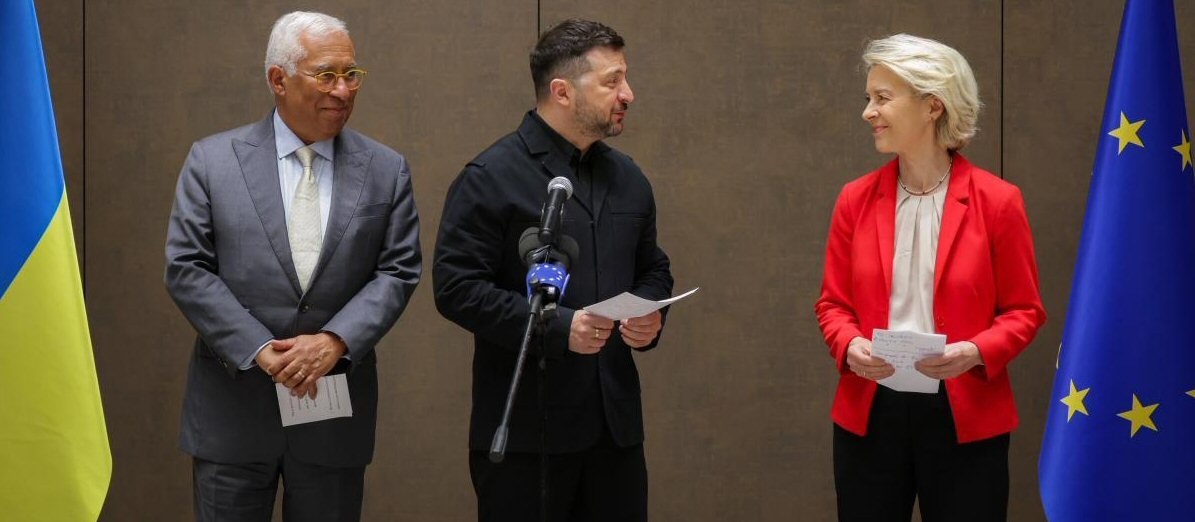
Photo credit: © European Union, 2026, licensed under CC BY 4.0.

Many thanks for this very helpful summary of the various statements and news reports. However, I miss any indication when Ukraine would have to contribute to the EU budget. Although all new member states will be net beneficiaries, potential contributions seem to be overlooked continuously. Do you see any reasonable evidence that it will be politically feasible to apply two different accession paths at the same time given the frequent disappointments caused on the Western Balkan side?
@Thomas, a good point, you are right that the expected contribution from new members to the EU budget is not often highlighted. We can make a rough estimate in the case of Ukraine, assuming that it became a member today and would make a contribution of, say, 1.1% of its GNI to the EU budget (its contribution will be a mixture of tariff revenue and a share of VAT receipts but the GNI component will be the largest element). Based on World Bank Indicators data, this share of Ukrainian GNI would amount to at least €1.7 and €1.9 billion annually (depending on whether we take the 2021 or the bigger 2024 GNI figure as the base). When accession occurs, I assume there would be some kind of transition or phasing in period so it would be a few years before the full contribution would be made.
On your final point, indeed, this is exactly the point I raise at the end of the post. How will the EU manage the very different expectations on the size of candidate countries, some of whom have been negotiating their accession for a very long period. The EU insists that everyone faces the same merit-based process, but there is also no doubt that the Ukraine represents a very specific political dimension. A crucial test, it seems to me, will be whether Montenegrin membership will be agreed in the near future. A good sign is that the last couple of weeks the Council agreed to establish an Ad Hoc Working Group to draft the Treaty of Accession, with a view to a membership date in 2028. It is very important that countries can see that the merit-based process and the new enlargement methodology can work.