

When the European Commission published its Fertiliser Action Plan (FAP) in May 2026, it set itself an ambitious objective:
“A successful strategy for fertilisation in the EU requires industry and farmers to work hand in hand in partnership and a transparent value chain: ensuring competitiveness for both farmers and the fertiliser industry and EU strategic autonomy, while helping to achieve EU climate and environmental objectives.”
That statement captures the central challenges of European fertiliser policy. Farmers need reliable supplies of nitrogen fertiliser at affordable prices to remain competitive. European fertiliser manufacturers seek protection from imports that they argue benefit from lower energy costs and weaker environmental standards. At the same time, the European Union wants to decarbonise fertiliser production, reduce nitrogen losses, and strengthen strategic autonomy.
Reconciling these objectives has become more difficult following the closure of the Strait of Hormuz in spring 2026 and the resulting increase in natural gas and fertiliser prices. The Commission’s Fertiliser Action Plan is therefore best understood not simply as a package of short-term support measures, but as an attempt to reconcile farmer affordability with domestic production, decarbonisation and strategic autonomy. Here we examine the tension between maintaining a domestic fertiliser manufacturing industry and ensuring the affordability of fertiliser, specifically nitrogen fertiliser, for farmers in the light of recent market and policy developments.
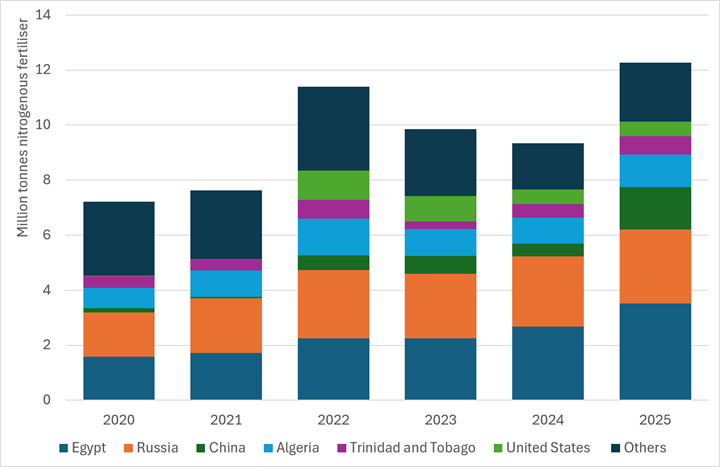
Europe remains a major producer of nitrogen fertilisers but also relies heavily on imports of both fertilisers and ammonia, while domestic ammonia production is dependent on imported natural gas. The main sources of nitrogenous fertilisers are Egypt, Russia and Algeria, with China emerging as an important supplier in 2025 (Figure 1). The 2025 figures are distorted by a surge in EU nitrogen fertiliser imports in late 2025 followed by a dramatic drop in early 2026, largely driven by anticipatory buying (“front-loading”) ahead of the January 1, 2026, implementation of the EU’s Carbon Border Adjustment Mechanism (CBAM), alongside new tariffs on Russian and Belarusian products.
Source: DG AGRI, Agri-Food Data Portal.
Traditionally, the tension between the fertiliser industry and farmers has revolved around trade policy. The industry has sought additional protection from unfair competition arising from subsidised imports through the imposition of anti-dumping duties. Definitive anti-dumping duties on urea ammonium nitrate imports from Russia, the US and Trinidad and Tobago were recently extended. Trade protection will increase further as a result of EU sanctions policy against Russia and Belarus. In June 2025 the EU adopted progressively increasing tariffs on nitrogen fertiliser imports from these countries, applicable from July 2025, with the aim of ending dependence on these supplies.
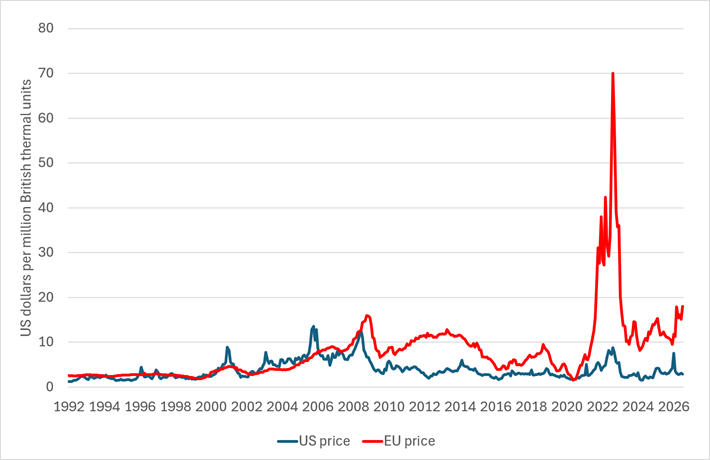
The industry’s competitiveness is strongly influenced by natural gas which accounts for 70-80% of the cost of nitrogen fertiliser production. Natural gas serves both as the principal feedstock for ammonia synthesis and as the primary energy source for the production process. Fluctuations in European gas prices are rapidly transmitted into production costs. In 2021, Russia’s pipelines supplied nearly half of the EU’s natural gas imports but unilateral reductions in Russian supplies in 2021 and 2022 drove natural gas prices in the EU to extraordinary levels (Figure 2).
The EU responded by shifting its imports to LNG suppliers which now account for nearly half of its gas imports. Natural gas prices have fallen, but EU fertiliser manufacturers still face a structural cost disadvantage compared to international competitors. Partly this reflects the additional costs of liquefaction, transport and regasification, but European prices also remain exposed to global LNG market conditions. The closure of the Strait of Hormuz in 2026 reinforced this new reality, resulting in a 53% increase in the European gas price by July compared to the pre-war level. But even if LNG prices fall back when the US-Iran conflict ends, the loss of low-cost Russian pipeline gas has exposed a structural cost disadvantage for European nitrogen fertiliser production relative to producers with access to cheaper energy.
Source: World Bank Commodity Pink Sheet.
The fertiliser industry also faces the challenge of decarbonisation. Fertiliser manufacturing including ammonia and nitric acid production has been covered by the EU Emissions Trading System (ETS) since its inception. However, as a sector deemed particularly vulnerable to carbon leakage, it was partially shielded from the full impact of ETS pricing through the grant of free allowances. Free allocation covered production according to benchmarks based on the emissions performance of the 10% most efficient installations. Fertilizers Europe estimates that, at an EUA price of €80 per tonne, the industry’s annual expenditure on purchasing additional allowances exceeded €500 million. This reflects the gap between benchmark performance and the actual emissions intensity of most European ammonia plants.
The revision of the EU ETS as part of the Fit for 55 package in 2023 fundamentally changed this approach. While free allocation helped to maintain the international competitiveness of emissions-intensive industries, it also reduced their exposure to the carbon price and therefore weakened incentives to invest in low-carbon technologies. As the EU adopted more ambitious climate targets, it sought an alternative instrument that would preserve protection against carbon leakage while allowing domestic producers to face the full carbon price. The Carbon Border Adjustment Mechanism (CBAM) was introduced to fulfil this role. By applying an equivalent carbon charge to imports, the CBAM enables free allocation to be progressively withdrawn without exposing EU producers to a competitive disadvantage relative to foreign producers operating under less stringent climate policies.
The original plan was to complete the transition from free allowances to CBAM by 2034. The fertiliser industry will receive a declining amount of free allowances during this transition. In July 2026, however, the Commission proposed extending the phase-out to 2037, while making continued access to free allowances conditional on submitting and implementing an approved plan to invest in decarbonisation in the EU.
The CBAM applies to imports of ammonia and the principal nitrogen fertilisers. Imported ammonia was not subject to ETS pricing. For fertiliser manufacturers relying on imported ammonia as a feedstock, the CBAM therefore represents an additional input cost that did not previously exist. At the same time, the progressive withdrawal of free allocation increases the carbon costs borne by domestic ammonia producers. The combination of these two changes increases the carbon cost of ammonia irrespective of its origin. Ultimately, much of this additional carbon cost is likely to be reflected in the price of nitrogen fertiliser paid by farmers.
The fertiliser industry, already burdened with the higher cost of natural gas, argues that the CBAM is essential if it is to hope to remain competitive against imports that do not bear an equivalent carbon cost. A recent academic study estimated that the combined effect of CBAM and the phase-out of free allowances could approximately double the price of mineral nitrogen fertiliser. Even if such estimates always come with caveats, recognising the carbon cost of fertiliser production will increase the price of this input for farmers. The future policy trajectory will therefore likely aggravate the affordability pressure already facing farmers, particularly arable farmers (Figure 3).
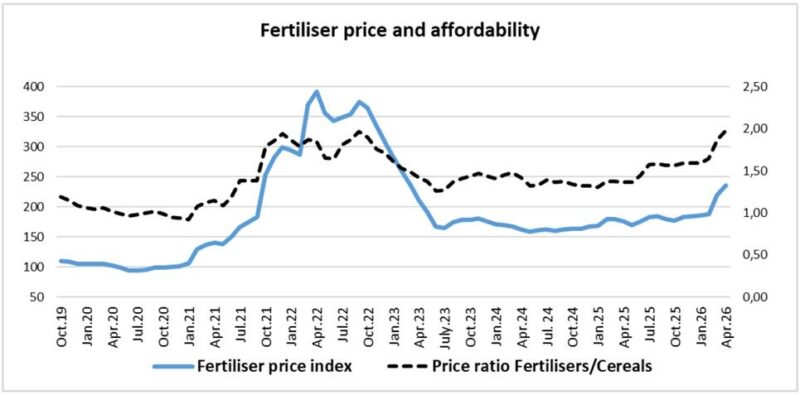
Source: Commission, Fertiliser Action Plan COM(2026) 310.
The Fertiliser Action Plan announces a set of short-term measures intended to address what it assumes will be a temporary increase in fertiliser prices due to the Iran war. Apart from authorising additional financial aid and liquidity support for farmers, the Commission has temporarily introduced duty-free import tariff quotas for ammonia and nitrogen fertilisers for one year which it estimates will lead to a saving of €60 million for farmers. It has also limited the markup applied to CBAM default values for fertilisers to 1%, compared with the standard markup of 10% in 2026, 20% in 2027 and 30% from 2028. These default values place an effective ceiling on the amount of carbon charge levied on imports and will thus limit but not remove the upward pressure on fertiliser prices due to CBAM.
The Plan advocates measures to improve nitrogen use efficiency and nutrient circularity in farming as well as greater use of nitrogen-fixing crops as a way for farmers to cope with higher fertiliser prices. These measures are desirable, indeed essential, also to contain the environmental damage due to losses of nitrogen to air and water. But they will not replace the need for supplies of mineral nitrogen for a competitive agricultural sector even if there were an immediate and dramatic change in the foods that European consumers eat.
The long-term aim is that green ammonia, produced using hydrogen generated by electrolysis with renewable electricity, will replace natural-gas-based hydrogen as the feedstock for the Haber-Bosch process. But this requires significant resources of cheap renewable electricity which Europe does not yet have in sufficient quantities at competitive cost.
The Fertiliser Action Plan is aware of these longer term affordability pressures on farmers built into the current policy mix. It commits to carry out an in-depth evaluation of how CBAM and ETS-related costs are passed on in the fertiliser prices paid by farmers and ultimately on food prices although there is no indication when this will take place. It would be prudent to begin to address this issue now, as the tension between the affordability of fertiliser for farmers and the competitiveness of European production will become increasingly difficult to manage.
This post was written by Alan Matthews. It originally appeared in Fertilizer Focus, Volume 45, Issue 3, Sept/Oct 2026 and is reproduced here with the kind permission of the editor.
Photo credit: Natural England, via Flickr, cropped, used under a CC BY-NC-ND 2.0 licence.
