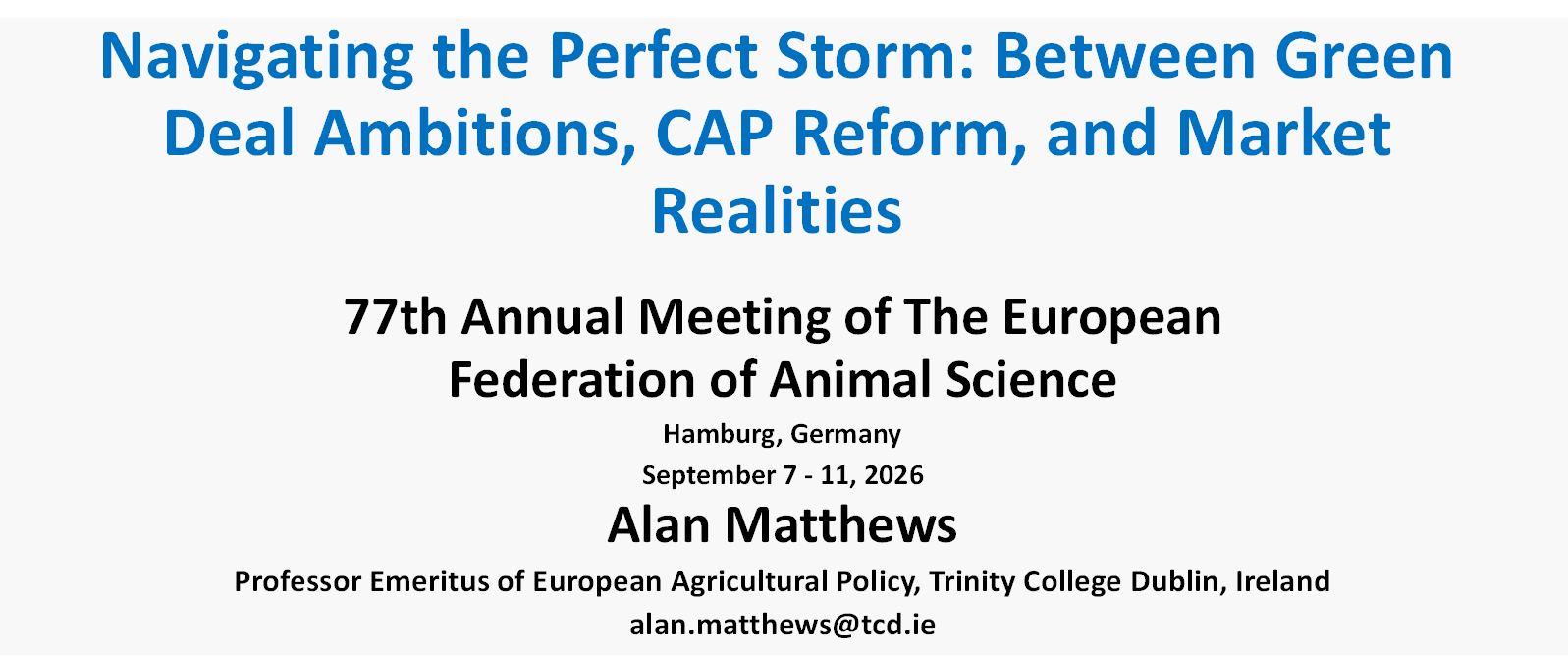


Today I had the pleasure to take part in a plenary session of the EAAP- European Federation of Animal Science annual conference in Hamburg. My contribution provided an overview and update of policy developments and challenges affecting the EU livestock sector. The talk was not a direct commentary on the Commission’s Livestock Strategy published in July this year, but it addresses many of the same issues. The presentation accompanying the talk can be downloaded here, and the whole plenary session can be viewed on the EAAP YouTube channel. I reproduce the talk more or less as delivered in this post.
The perfect storm
Let me begin by stating the obvious. Livestock is of major economic and political importance to the European Union.
It accounts for around 40% of agricultural value added. It generates some €400 billion in annual turnover and supports around 7 million people across the value chain. The Commission’s recently-published Livestock Strategy identified the sector as key for competitiveness and open strategic autonomy. These economic characteristics also give the industry political weight. The sector has strong producer organisations and well-established relationships with policymakers.
But livestock is also changing. Animal numbers have been declining in most major sectors. Production is becoming more concentrated on fewer, larger and more specialised farms. Just 6% of farms account for more than 70% of EU livestock units.
At the same time, the economic and policy environment in which livestock farmers operate is changing rapidly.
The extent of future policy support is uncertain. A changing climate brings increasing challenges. Environmental and societal expectations are rising. Global markets are becoming more competitive and less predictable. A successful protein transition would have implications for the demand for livestock products.
This looks to me like a kind of perfect storm for European livestock agriculture. Let us now look at each of these issues in turn.
Storm front 1. Potentially lower policy support
First, some context. Livestock is not one economic sector. There are very large differences between production systems. Specialist pig and poultry farms have much higher returns to labour, measured by farm net value added per agricultural work unit, than cattle and sheep farms.
And yet the contribution of CAP subsidies is much greater in grazing systems, accounting for 43% of farm income in the most recent year compared to around 21% for EU holdings as a whole but only 6% for pig and poultry farms. This means the same policy change can have very different consequences across livestock agriculture.
At the same time, many livestock farms face a substantial investment challenge as well as difficulties in recruiting labour. And that brings us to perhaps the most fundamental structural issue: generational renewal. Only a small share of livestock holdings are managed by farmers under 40, while around one third are controlled by farmers aged 65 or over.
So the question is not simply whether livestock farming is profitable today. It is whether there is an economic future that will attract the next generation. The CAP remains central to that future. But the CAP itself is changing.The current CAP attempted to incorporate the Green Deal within the existing policy framework. The Commission’s post-2027 proposal takes a different approach.
The familiar instruments remain. But there is more targeting of income support, with stronger degressivity and capping of direct payments. The ceiling on coupled support for ruminants is relaxed. A stronger safety net for market disturbances including those caused by animal disease outbreaks is also proposed.
The environmental architecture also changes. Eco-schemes and agri-environment-climate measures would be combined into a broader system of agri-environment-climate actions. These can provide support for climate adaptation, mitigation, carbon removals, soil health, biodiversity and animal welfare.
A significant new element would be the requirement to give support for livestock extensification and diversification in areas affected by nitrate pollution. Specific support for mixed farming systems and transition support also feature in the proposal.
At the same time, the environmental framework would become less prescriptive. Member State discretion increases. And there is no longer a specific ring-fenced amount for agri-environment-climate actions. So the future environmental ambition of the CAP will depend more heavily on national choices.
These of course are the Commission proposals, and there will be changes introduced during the legislative process. And there is another uncertainty, and it may be more important still: money.
The Commission proposal for the Multi-annual Financial Framework for the period 2028-2034 is ambitious. It calls for a total budget of almost €2 trillion which is a significant increase compared to the current MFF.
Most of the increased budget would go to new EU spending priorities, including industrial competitiveness, security and migration. Still, the Commission proposal would maintain spending on the traditional areas of agriculture and cohesion at their current levels in nominal terms. Within that spending the Commission has proposed a minimum CAP allocation of around €294 billion for 2028–34. In nominal terms, that would be a reduction of about 23% below the current CAP budget.
However, Member States have both the obligation and the possibility to supplement this from the wider National and Regional Partnership Fund. The Commission argues that the CAP budget will end up approximately equal to the current budget in nominal terms.
But it is clear to everyone that the overall MFF is now entering a difficult political negotiation, with a sharp divide between Member States favouring a more ambitious EU budget and the so-called frugal or budget-modernising countries. Substantial differences remain between Member States over the size of the budget, its allocation across headings, and how to finance it.
If cuts are made, the consequences for the livestock sector will depend on where they fall. If the CAP budget is further reduced, grazing livestock systems will be particularly exposed because of their dependence on CAP payments.
So that is the first element of the perfect storm: an economically differentiated sector facing a changing and potentially more constrained system of public support.
Storm front 2. Climate change impacts
Climate change presents a rather different challenge. First, it is becoming a production risk for livestock farmers themselves.
Higher temperatures and heatwaves affect feed intake, growth, fertility and milk production. Drought affects pasture and forage. Water scarcity creates additional pressures. Flooding disrupts housing, transport and feed supplies. And climate change can alter disease risks.
Adaptation therefore requires investment. The EEA estimates that climate adaptation in EU agriculture could require €7–8 billion a year to 2050 under a moderate emissions scenario, and considerably more under a high-emissions scenario. Not all of that is relevant to livestock. But the scale gives an indication of the investment challenge.
Mitigation is a different issue.
Agricultural emissions have declined, but agriculture remains an important source of greenhouse gases, with emissions from livestock production accounting for two-thirds of these emissions.
Methane from enteric fermentation is the single largest component, followed by nitrous oxide from soils and emissions from manure management. This has given rise to a considerable discussion about how livestock methane should be measured.
GWP100 and GWP* tell us rather different things about the climate effects of stable, rising or declining methane emissions because methane is a short-lived gas. But this is a debate about how we measure the climate effect, not about whether methane matters. Increasing methane emissions increase warming. Sustained reductions reduce warming pressure. So changing the metric does not remove the case for mitigation.
There is another relevant angle to consider for grazing livestock. Permanent grasslands can store substantial amounts of carbon. Well-managed grazing can help maintain those stocks.
This is now reflected in EU policy through the Carbon Removals and Carbon Farming Regulation, which establishes a framework for certifying carbon farming removals and is intended to create a basis for rewarding farmers for verified increases in carbon storage.
But the potential for soil carbon sequestration cannot be treated as a simple offset against livestock emissions: increases in soil carbon are uncertain and highly dependent on soil, climate and management conditions, while the permanence of additional storage also matters.
Agriculture is covered by the Effort Sharing Regulation, but it does not currently face a European carbon price comparable to the EU ETS.
Other sectors increasingly do.
So far, livestock farmers have faced relatively little direct cost for mitigating their own emissions. Policy has relied mainly on the CAP, voluntary measures, investment support and improvements in technical efficiency and productivity.
There is no sign that this approach will change in the immediate future. The CRCF Regulation required the Commission to report by July this year on including reductions in emissions from enteric fermentation and manure management within the carbon farming initiative. The Livestock Strategy indicates that this review is still underway. This would open the possibility of attracting public or private finance for measurable reductions in livestock emissions.
But this voluntary approach will come under increasing pressure as, over time, agricultural emissions become increasingly visible as other sectors decarbonise.
The Commission’s climate watchdog, the European Scientific Advisory Board on Climate Change, has advocated including agricultural emissions within a pricing regime. Denmark has agreed a livestock emissions tax beginning in 2030. Food companies and retailers are increasingly asking suppliers to measure and reduce emissions.
There are also indirect costs arising from climate policy.
The Carbon Border Adjustment Mechanism does not put a carbon price directly on livestock. But fertilisers are covered. Fertiliser is an important input into feed production and grassland management and, as the carbon cost of fertiliser production rises, livestock production will face higher input costs.
So the climate challenge is becoming a two-sided problem. Farmers already face the costs of adapting to climate change. The costs of mitigating their own emissions are still largely externalised. But that second situation is becoming harder to sustain.
Storm front 3. Environmental constraints
Climate is only one part of the environmental challenge. And here the key point is that the environmental problem is not simply the number of animals. It reflects the interaction between livestock numbers, the production system, the land available to absorb nutrients and the spatial concentration of production.
At high livestock densities, there may simply not be enough surrounding land to absorb the nutrients safely. That is why environmental pressures are concentrated in particular regions: Flanders, the Netherlands, Brittany, northern Germany, the Po Valley and Catalonia, among others.
Different livestock systems create very different environmental outcomes. Extensive grazing can maintain valuable grasslands and habitats when stocking rates are appropriate. Intensive pig, poultry and dairy systems can sustain high animal densities because feed can be brought in from elsewhere. But this also means very large concentrations of animals and manure can accumulate in places where the surrounding environment cannot absorb them.
So the question is increasingly not simply whether a farm complies with environmental standards. It is whether the territory can accommodate more livestock.
The economic consequences can be substantial. The Commission has estimated that the cost of nitrogen pollution from agricultural sources amounted to between €68-182 billion annually in 2023 prices. Adjustment costs for the livestock sector were estimated at around €2 billion annually, arising from the costs of excess manure disposal, transport and processing, mainly concentrated in Belgium and the Netherlands.
The Netherlands is perhaps the clearest warning. There, cumulative nitrogen pressures have become a constraint not only on individual farms but on new economic development more generally.
The lesson is not that environmental regulation will make European livestock farming universally uncompetitive. In most of Europe, the costs remain modest relative to agricultural output.
The lesson is different. Where livestock becomes highly concentrated, environmental costs can rise rapidly. Eventually, the constraint may no longer be the cost of complying with regulation. It may be whether further livestock production is environmentally or legally possible in that location.
Storm front 4. Animal welfare
Animal welfare adds another source of pressure. Public concern is substantial, as demonstrated by successive Eurobarometer surveys.
The current policy debate focuses particularly on pigs and poultry. For pigs, there are debates over farrowing crates, tail docking, enrichment, stocking densities and breeding. For laying hens, the central issue is the move towards cage-free production. For broilers, fast-growing breeds and stocking densities are major concerns.
Accommodating these concerns will not be costless. Slower-growing birds require more feed, more time and more housing space. Changing housing systems requires investment.
Better animal welfare can reduce disease, veterinary costs and antimicrobial use. Some characteristics of intensive livestock production, particularly high stocking densities, rapid growth and large concentrations of susceptible animals, can increase the transmission and consequences of disease outbreaks. For farmers, animal disease can mean mortality, culling, movement restrictions, veterinary costs and lost production.
There is also a public health dimension: better animal health can reduce the need for antibiotics, acknowledging that their use in the EU has already fallen considerably, and can help reduce some risks of zoonotic disease.
This provides an additional public interest rationale for improving the health and welfare conditions under which livestock are produced.
The policy debate is also changing.
The EU has had animal welfare legislation since the 1980s. But the emphasis is moving from minimum standards towards more comprehensive changes in production systems. The End the Cage Age citizens’ initiative, with more than 1.4 million signatures, was an important political turning point.
The Commission committed to phasing out cages. The 2025 Vision for Agriculture and Food renewed that commitment. And the 2026 Livestock Strategy now provides a timetable for legislative proposals covering laying hens, broilers and pigs.
The Commission intends to propose, by the end of 2026, a targeted revision covering laying hens and broilers, including the phasing out of cages, practical on-farm welfare indicators and an end to the systematic killing of male chicks. By the second quarter of 2027, it intends to propose a revision of the rules for pigs, including the transition from crates to pen systems.
The economic question is straightforward. Who pays? There is an important distinction between what people support as citizens and what they are willing to pay for as consumers.
People express very strong support for higher welfare. But willingness to pay the full cost is much weaker. That creates a difficult policy question.
Are we correcting a production practice that society considers unacceptable? If so, regulation should establish a minimum standard. Or are we asking farmers to provide an additional welfare attribute that citizens value? Then the question becomes: who should pay?
Farmers fear that higher standards will simply raise their costs. California’s Proposition 12 is instructive because its welfare requirements applied not only to Californian producers but also to products sold in California from outside the state.
That changes the economics. If the standard applies to all products in the market, much of the additional cost can be passed through to consumers in higher prices. The EU is moving towards the same principle. Its Livestock Strategy proposes equivalent welfare requirements for imported products. Still, higher welfare standards add to the investment and cost pressures facing livestock farmers.
And they do so at the same time as CAP support may come under pressure and international competition is increasing.
Storm front 5. Global competition
Another major pressure comes from global markets.
The EU is a major exporter of animal products. In 2025, exports were around €53 billion, compared with imports of €16 billion. Dairy is particularly successful, as is pigmeat. But beef, sheepmeat, poultry and eggs face much stronger competitive pressures.
The international market is also changing. Global demand for meat is expected to continue to grow, particularly for poultry. But this does not mean that European exporters will automatically benefit. Based on recent OECD-FAO projections shown in this slide, the EU is projected to lose export share in all three major meat markets.
The reasons differ. Beef faces a structural cost disadvantage. China is becoming more self-sufficient in pigmeat. And emerging producers are becoming more competitive in poultry.
Dairy is more differentiated. The EU is expected to remain competitive in higher-value products such as cheese and whey, even while losing ground in some commodity markets.
But there is another change that may be even more important.
For much of the post-war period, international trade operated within a relatively predictable rules-based framework centred on the WTO. Trade now takes place in a rapidly changing geopolitical landscape marked by rising trade tensions, strategic competition, and economic security considerations.
The US has increasingly used tariffs as a negotiating instrument. Russia’s 2014 food embargo showed how quickly geopolitical conflict can close an important agricultural market. China’s actions against Australian beef and, more recently, EU pork show how trade measures can become entangled with disputes in other sectors.
The problem is therefore not that tariffs are new. It is that market access can increasingly be changed for reasons unrelated to the underlying economics of the product.
That increases uncertainty for exporters.
There is also a more fundamental tension in EU trade policy. The EU is both an exporter and a protected market. Dairy has strong offensive interests. Beef, sheepmeat, poultry and eggs have much stronger defensive interests.
This explains why livestock is so politically sensitive in trade negotiations. Trade liberalisation can create an overall economic gain while imposing concentrated adjustment costs on particular groups of producers.
The Commission’s analysis of recent trade agreements shown in the graphic illustrates this clearly. It projects substantial gains for EU dairy and pigmeat exports, but significant increases in imports of beef, sheepmeat and poultry.
The political problem is therefore not simply free trade versus protection. It is how to manage very different interests within the livestock sector.
There is a third trade issue: production standards. European producers face higher environmental, climate and welfare requirements. They argue that imported products should meet equivalent standards.
There is a legitimate distinction here. EU rules on food safety and animal health can clearly affect market access but are permitted under WTO rules provided they are based on scientific evidence applied consistently. International trade rules are much less definitive when the EU seeks to regulate the way a safe product was produced.
That is the issue behind so-called reciprocity or mirror clauses, and the EU is already moving in this direction. From September 2026, imports of animal products will have to meet EU restrictions on certain antimicrobial uses. The current prohibition on meat imports from Brazil illustrates its practical effect. Trade agreements do not override EU regulatory requirements.
But mirror clauses are not costless. They can raise compliance costs for foreign producers, provoke WTO disputes and create opportunities for retaliation. So they may protect European producers, but they can also complicate European trade interests.
There is another vulnerability that is particularly relevant for intensive livestock: imported high-protein feed. The EU’s overall net protein dependence is around 15%. But for high-protein feed around three quarters of supplies are imported, and around 94% of soya protein is imported.
Pig and poultry production account for most of the use.
This is not necessarily inefficient. Europe imports protein from regions where it can be produced competitively. The issue is exposure to a potentially serious external shock.
The Commission’s 2026 Protein Action Plan therefore aims to increase domestic protein production, diversify imports and develop local value chains. The target is to raise the EU share of protein from oilseeds and protein crops used in livestock feed from about 26% in 2025 to 35% in 2035.
But resilience has a price. European protein crops can be more expensive. Yields can be lower. Processing and marketing chains are less developed. So the policy question is how much resilience is worth paying for.
And this illustrates a wider point. Measures designed to reduce vulnerability can themselves increase production costs.
Storm front 6. The protein transition
This brings me to perhaps the most disruptive possibility for livestock: the protein transition. There are several pathways. One is a dietary transition, in which people consume more plant foods and less animal-source food. The other is a technological transition, in which we continue to consume foods that resemble meat and dairy but produce them without animals. That includes plant-based and fermentation-based products, and potentially cultivated meat.
But the behavioural challenge is substantial. European diets have changed, but not yet on anything like the scale required for a major transition away from animal products. Beef consumption is declining. Poultry has gained. Pigmeat is expected to decline. Dairy consumption is broadly stable, although its composition is changing.
And the most important group may not be vegetarians or vegans. It may be flexitarians. The important transition could therefore be a gradual reduction in the amount and frequency of animal-source food consumed.
Plant-based products may reinforce that change. But so far, plant-based meat has not transformed the market. Consumers try these products, but repeat consumption is much lower.
And technological alternatives are not yet serious market players, there remain substantial challenges to scaling up technological alternatives to animal protein.
The proposition put forward in Bruce Friedrich’s recent book Meat is that this could quickly change if alternatives achieve price and sensory parity with conventional meat. That is possible. While private investment interest has fluctuated, we also see public research initiatives underpinning the basic science as well as supporting scaling up.
But we also see industry mobilisation to slow down these developments, notably the recent restrictions introduced on the use of meat and meat-related terms.
Alternative proteins currently remain commercially limited. The protein transition remains a hypothesis about the future but it could become a serious competitor to livestock production in the longer term.
The future role for animal science
What do these storm fronts mean for European livestock farming? And what does this mean for animal science?
The first point is that the research agenda is changing. Improving feed efficiency, animal health and fertility will remain important. But the remarkable gains in animal productivity achieved over recent decades have not removed the environmental, welfare and resilience challenges facing livestock. In some cases, the pursuit of productivity has contributed to those challenges, particularly where it has encouraged greater intensity and concentration.
The question is not whether we should stop improving animals. It is what we are improving them for.
There is also a wider question about how the research agenda is shaped. Much of the technology through which animal productivity is delivered is now supplied through concentrated commercial markets, particularly in genetics and some areas of animal nutrition. The commercial incentives facing these companies are not necessarily the same as the wider social objectives we are now asking livestock systems to meet. A company has an obvious incentive to develop technology that improves productivity. It does not necessarily have the same incentive to ask whether society wants more animals, fewer animals, different animals, or livestock in different places.
This makes it even more important that animal science engages with the wider system in which those technologies are used.
The pressures for change are coming from both markets and social preferences. European producers face stronger competition from lower-cost producers elsewhere. They face higher environmental and welfare costs, potentially lower support to meet those costs, and potentially growing competition from alternative proteins.
Some European livestock production is therefore likely to contract. Fewer animals will be necessary in some places because of environmental constraints or changing social expectations.
This is where political economy enters the picture. Livestock is an economically and politically powerful sector. Millions of farms and workers depend on it. There are large investments in buildings, equipment, processing and infrastructure. Producer organisations are influential. So there are powerful interests in maintaining existing systems.
We should therefore not be surprised that the debate is contested. The controversies surrounding the Dublin Declaration and the FAO Global Action Plan for Sustainable Livestock Transformation illustrate how disagreement about the future of livestock can become disagreement about the evidence itself.
We need to recognise much more explicitly the heterogeneity of livestock systems. A grazing system operating at an appropriate stocking rate on semi-natural grassland is not the same proposition as a highly concentrated pig or poultry system in a nutrient-saturated region. Their economic, environmental, animal welfare and resilience characteristics can be very different.
The question is which livestock systems have a future, where they have a future, what characteristics those systems will need, and how they can change in a way that is economically viable, environmentally credible and socially acceptable.
That seems to me a research agenda in which animal science has a great deal to contribute.
This post was written by Alan Matthews.
