



One of the many debates around the Commission’s post-2027 CAP proposal revolves around its proposal for the better targeting of area-based payments. This debate has at least five dimensions:
- Article 6(2) of the draft CAP Regulation COM(2025) 560 requires that Member States differentiate these payments by groups of farmers or geographical areas, on the basis of objective and non-discriminatory criteria. The basis for the differentiation of payments shall be based on farmers’ income from agricultural activity in a representative reference period. Specifically, differentiated payments should focus on those most in need (with specific groups mentioned including young and new farmers, women farmers, small farmers, mixed enterprise farmers and those operating in less favoured areas).
- Article 6(3) requires Member States to apply degressivity to area-based payments between €20,000 and €100,000.
- Article 6(4) requires Member States to cap the amount of area-based payments any one beneficiary can receive at €100,000.
- Article 6(5) requires that Member States ensure that area-based payments are primarily directed towards farmers who exercise an agricultural activity and actively contribute to food security. I have previously discussed the complexities introduced by the Commission around its new definition of a farmer and how this relates to the ‘active farmer’ definition in the current CAP in this post.
- Article 6(6) requires Member States to ensure that at the latest by 2032 applicants who reach the retirement age, determined by national law, and who receive a retirement pension, no longer receive area-based payments.
In this post, I look at the amendments proposed by the COMAGRI rapporteur on the CAP Regulation file, Norbert Lins (EPP), to amend specifically Article 6(3) on degressivity. I do not pursue the debate whether targeting support on smaller farms is desirable or not (I prefer to frame this debate as limiting area-based income support payments to larger farms who should not need it, but I leave the arguments for and against this to another day). Rapporteur Lins accepts the principle of targeting but proposes to implement this in a different way to the Commission proposal.
He argues that using a mandatory redistributive payment is a better approach to targeting than the degressive area-based income support (DABIS) payment which he proposes to abandon. He would also leave capping at €100,000 voluntary for Member States, as under the current CAP Regulation, but would introduce a new mandatory cap at €500,000 per natural person per year. In this post I examine the consequences of substituting a mandatory redistributive payment for the DABIS payment.
The Lins amendment
Under the Commission proposal, Member States are at liberty to introduce a redistributive payment on first hectares. Small farms are specifically mentioned as recipients of differentiated support in Article 6(2). Lins proposes to make this payment mandatory and to require Member States to allocate 15% of the amount proposed for area-based payments to this payment (Amendment 54) while at the same time eliminating the DABIS payment (Amendment 48).
Under the current CAP, the redistributive payment CRISS is also mandatory. Member States are required to allocate a minimum of 10% of their adjusted direct payments ceiling (after transfers between funds) to this payment (with the possibility of getting Commission approval for a lower or zero percentage if the Member State can show in its Strategic Plan that it is addressing the need for a fairer distribution through other instruments and interventions). The CRISS payment is not only paid to smaller farms under the threshold; it is paid on the first hectares of all farms, although under the current CAP Regulation Member States are allowed to set a maximum size of farm for which the CRISS payment can be made.
Lins’ amendment requires a fixed 15% proportion of the amount allocated to area-based payments. This removes some discretion from Member States as there are several Member States that decided to allocate more than the minimum 10% to the CRISS payment (Commission 2023). The 15% cannot be directly compared to the 10% figure in the current Regulation as it excludes coupled support and cotton payments from the base payments figure. More important, the base payments figure (the amount allocated to area-based payments by a Member State) can also vary (between an average €130 and €240 per eligible hectare in the Commission proposal and between an average €130 and €200 per eligible hectare in another Lins amendment (Amendment 53)).
Member States would continue to have considerable flexibility in how they design their redistributive payments, for example, to decide the number of first hectares covered and whether to introduce different amounts for different hectares. It is thus not possible a priori to make a judgement on the comparative distributional impacts of replacing the DABIS payment by a mandatory redistributive payment. In any case, this will also depend on the structure of holdings in each individual Member State.
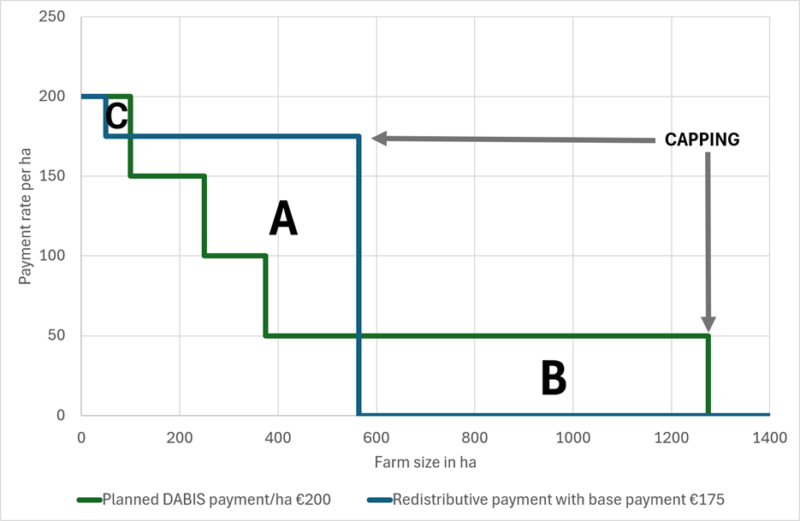
In theory, it would be possible to mimic the effect of degressivity through a carefully designed redistributive payment. Figure 1 shows the DABIS payment per hectare based on a planned payment of €200/ha under the Commission’s degressivity formula (green line). This could be replicated under a redistributive payments mechanism if a MS introduced a base payment of €50 and added redistributive amounts for the different hectare steps shown in the diagram (for example, added a payment of €150/ha on the first 100 ha, and so on). Its ability to do so might be constrained by other rules. For example, in the current CAP Regulation, the amount of the CRISS payment cannot exceed the national average amount of direct payments per hectare, although this restriction is not included in the Lins amendment. If the total allocation were also capped, this could also constrain the ability to exactly mimic degressivity.
Redistributive payments vs. degressivity
We now proceed to develop a more plausible scenario to compare the distributional implications of a redistributive payment compared to a degressive payment. To focus on the key elements, we assume a uniform payment on first hectares for the redistributive payment. This is then combined with a base level of area payment in the redistributive payment scenario. We abstract from any other differentiation as required by Article 6(2). We also assume that Member States decide to allocate a fixed budget to area-based payments. Because degressivity gives rise to financial savings, this means that the base level for the DABIS payment (the planned average level) will be higher than for the base level of the redistributive payment. We consider the implications of this assumption later.
Figure 1 shows a situation where I assume a base payment of €200/ha for the DABIS payment and for the redistributive payment a base payment of €175/ha and a redistributive payment of €25/ha on the first 50 ha. The €175/ha and €25/ha is an arbitrary choice of base and redistributive payments, respectively. We would need information on the size distribution of holdings to be able to calculate the precise levels of payments to ensure that the two scenarios involve the same amount allocated to area-based payments. I later look at the impact of varying these amounts. For both the redistributive payment scenario and the DABIS scenario I assume capping is introduced at a level of €100,000, although this is not essential to the argument.
I have labelled areas A, B and C in Figure 1. The diagram shows payment per hectare for different farm sizes and not the total payment received by these farm sizes. This would also depend on the number of farms in each farm size category. But let us think of the areas A, B and C as representing the differences in the total payment received by farms in the different size categories under each scenario (which would be reasonable if there were an equal number of farms in each size class). Recall that to make a like-with-like comparison requires that the total budget allocated to area-based payments in both scenarios is the same. This means that the base and redistributive payments should be chosen to ensure that the area A (now assumed to represent the additional spending in the redistributive payment scenario on the farms in this size group) equals the areas B and C (now assumed to represent the additional spending on these groups of farms in the degressivity scenario).
Because it is not the case that there is an equal number of farms in each size class, the areas A, B and C shown in Figure 1 are very misleading guides as to the total payments they represent. Area B, for example, looks big because it covers a wide range of farm sizes, but there will be relatively few farms in that size range. Area C looks small because it covers a relatively narrow range of farm sizes, but because there will be many farms in that size range the difference in total payments that it represents will be much more significant than shown in Figure 1.
I have arbitrarily assumed that a base payment of €175/ha together with a redistributive payment of €25/ha on the first 50 hectares fulfils the condition of a balanced area-based payments budget. Despite this arbitrary assumption, the comparison allows a tentative conclusion on the differences in distributional outcomes between the two mechanisms.
For the small farm sizes (those up to the threshold for the first hectares payment in the redistributive payment model) both instruments could achieve the same desired outcome in terms of payment per hectare. Medium-size farms with areas larger than the first hectares threshold but smaller than the areas that would attract a payment of €20,000 under the degressivity formula would be better off under degressivity (these are the farms represented by the area C). This is because the planned base payment under degressivity would be higher than the base payment under the redistributive payments formula.
Once the first step of the degressivity formula is reached, larger farms projected to receive between €20,000 and €100,000 would be better off under the redistributive payment, as they would avoid the degressivity cuts (these are the farms represented by the area A). However, precisely because of this, the cap of €100,000 would become binding for farms of a smaller size than under the degressivity formula. Farms above 557 ha in size would receive no payments on additional hectares under the redistributive payment scheme with capping, whereas a farm would have to be 1,275 ha before additional hectares would receive no payments under degressivity.
The payments to these farms under the degressivity scenario are shown as area B. However, this does not mean that these farms are better off under degressivity. By construction, their total payments are smaller than the €100,000 cap which they would receive under the redistributive payment, so these farms are also worse off under degressivity. Once capping applies, farms are indifferent to which scenario under which their payments are capped. But capping is not essential to the conclusion. Without capping, larger farms are always better off under the redistributive payment.
In Figure 2, I present an alternative redistributive payments scenario where I assume that a base payment of €140 plus a redistributive payment of €60 would require the equivalent budget to the DABIS payment with a planned average payment of €200/ha. The lesson from this scenario is that the number of medium-sized farms who would prefer degressivity increases (all farms between 50 and 250 ha), while all farms above 250 hectares would lose out from degressivity. Where capping applies and is binding, farms that are big enough to be capped are of course indifferent to the scenario implemented.
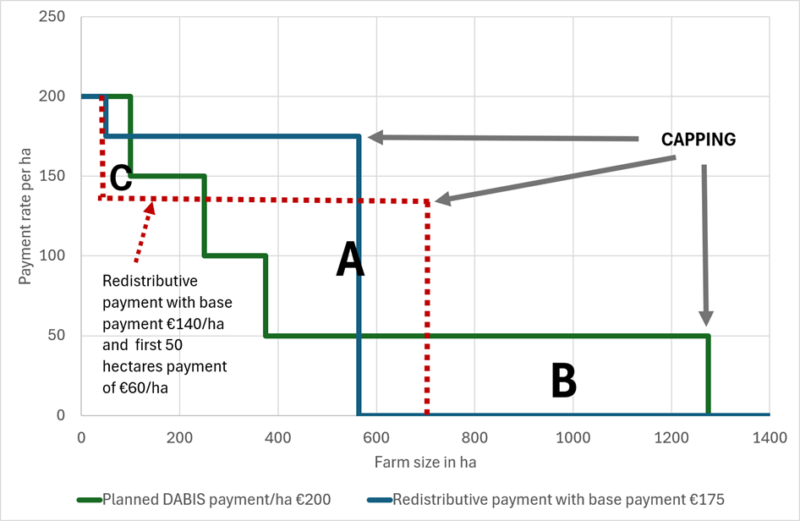
These thought experiments suggest that the Lins redistributive payment scheme and the Commission’s DABIS proposal have different distributional implications for farms of different sizes. Our tentative conclusion is that small farms will be indifferent between a mandatory redistributive payment scheme and degressivity (also keeping in mind that even with degressivity some additional redistributive payment is likely to be introduced under Article 6(2)). There is potentially a group of medium-sized farms (those between 50 and 100 hectares in my Figure 1 example and those between 50 and 250 ha in my Figure 2 example) that will receive a higher per hectare payment on these hectares over 50 ha under the degressivity formula. But all larger farms receiving more than €20,000 in total payments in Figure 1 or €50,000 in Figure 2 would be better off under the redistributive model than with the DABIS payment. The DABIS payment is more effective at limiting payments to larger farms (especially in the absence of capping) and also at protecting payments to medium-sized farms compared to a mandatory redistributive payment.
Modifying the budget assumption
I have assumed in the previous analyses that savings arising from degressivity are recycled into area-based payments and thus allow a higher projected base level DABIS payment than the base level redistributive payment. This is based on the assumption that Member States will decide a priori how much of their minimum CAP ring-fenced budget they want to allocate to area-based payments relative to other CAP interventions. They can then decide on the various rules to determine the extent of differential payments within that overall area-based payments budget.
Another interpretation is possible. The Commission proposal is based on the idea that Member States have to adopt a “planned average aid per hectare” for DABIS support which, when multiplied by the number of hectares benefitting, determines the potential DABIS budget. The potential DABIS budget is determined by the “planned’ average aid per hectare and not, as I have assumed, by the implemented average aid per hectare. This would mean that the savings generated by degressivity would not be recycled into increased area-based payments but would be used to finance other CAP instruments.
Even if we compare a redistributive payments scheme with a DABIS budget based on “planned” amounts, the base payment for the redistributive payment scheme will still fall below the base DABIS payment. This is because the budget for the redistributive payment scheme must also finance the redistributive payment on first hectares which is not an inherent element in DABIS. Recall that the payment on first hectares is paid to the first hectares on all farms. As long as the base payment in the redistributive payments scheme lies below the planned amount in DABIS, some farms will fall into the areas marked C in Figures 1 and 2 where their payments are lower under the redistributive payments mechanism compared to a DABIS payment.
But this is a somewhat fanciful comparison. When Member States run their simulations to decide if they would prefer the Lins amendment to the Commission proposal, it makes more sense in my view to assume that they will compare these alternatives under the assumption of a fixed area-based payments budget. Figures 1 and 2 are therefore the relevant illustrative examples to make these comparisons.
Conclusions
Norbert Lins, the COMAGRI rapporteur for the post-2027 CAP Regulation, has proposed to replace the Commission proposal for a degressive area-based payment with a mandatory redistributive payment to reach 15% of the budget for area-based payments. My aim in this post is to throw light on the likely distributional implications of such a substitution. With this proposal, Lins does not outright reject the objective of targeting direct payments more on smaller farms but he argues that this is a simpler method to achieve this objective.
Not surprisingly, the distributional implications of the two mechanisms will be different.
My analysis suggests that both instruments can provide a similar level of income support for the smallest farms (those farms up to the size determined for the payment on first hectares). This is particularly the case as the use of a redistributive payment is foreseen in combination with the DABIS payment in the Commission proposal.
Medium-sized farms will be better off under the Commission’s DABIS proposal, they will be worse off under the Lins amendment.
Large and very large farms will be better off under the Lins amendment which would significantly benefit very large farms if there is no capping.
We conclude that the Lins amendment protects the payments going to large and very large farms while lowering payments to medium-size farms, but likely not having a significant effect on the payments received by the smallest farms. I would be interested to know if readers agree with this conclusion, or if there are other factors that also need to be considered.
A final addendum. Some evidence of the likely impact of a redistributive payment will be provided by the annual DG AGRI report on the distribution of direct payments for claim year (CY) 2023 (financial year 2024) when this becomes available. This would be the first year of operation of the current CAP which replaced a voluntary redistributive payment in 2014-2022 by a mandatory one in 2023-2027. Under the previous voluntary system, nine MSs implemented the redistributive payment amounting to €1.6 billion in CY 2020 or 4.3% of the total direct payments envelope. In the current CAP, on average around €4.0 billion is allocated to the CRISS payment equivalent to 10.7% of the overall adjusted direct payments envelope (Commission 2023). The CY2023 data can help us to understand the extent of the redistribution due to this additional payment. Despite its relevance, DG AGRI has yet to make the report available.
This post was written by Alan Matthews.
Photo credit: European Parliament
