Antibiotic legislation as a mirror clause

The first priority of the French EU Presidency in the first half of 2022 under the ‘Agriculture and forestry’ heading is to ‘encourage Council discussions on reciprocal environmental and health production standards for European products and products imported from third countries with the aim of subjecting imported products to certain production requirements applied in the European Union where necessary, to strengthen the protection of health or the environment on the largest possible scale, in keeping with World Trade Organization rules (“mirror clauses”)’.

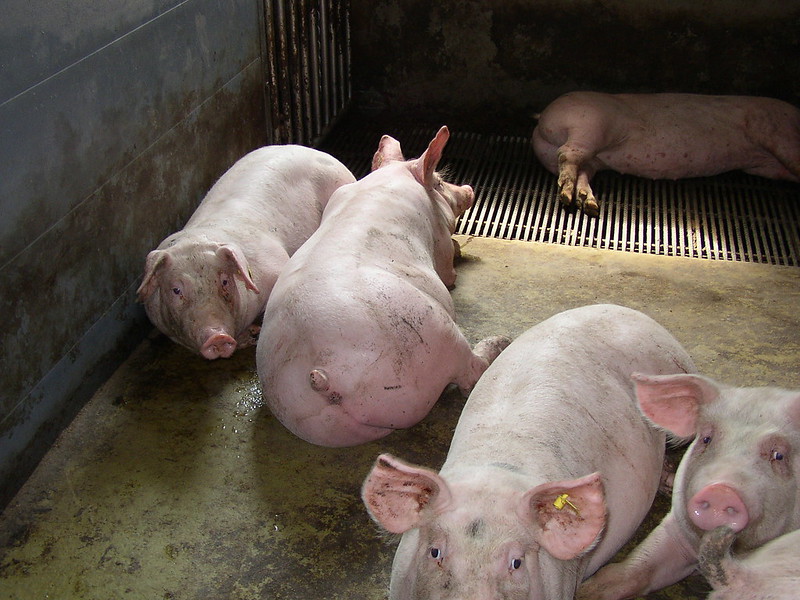
One of the issues on the French Presidency agenda will be the completion of the outstanding legislation necessary to fully implement the Veterinary Medicinal Products (VMP) Regulation (EU) 2019/6. This legislation came into actual effect last Friday 28 January 2022. It can be seen as the first example of the use of a mirror clause for the protection of health. It imposes additional restrictions on the use of antibiotics for animal production in the EU and extends certain of these restrictions to imported animals and animal products.… Read the rest
Price formation in the market for organic products

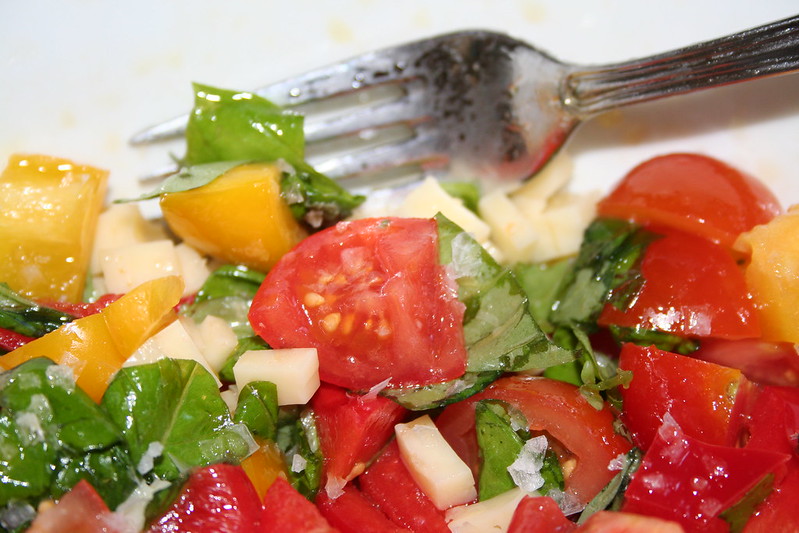
The Dutch Authority for Consumers and Markets (ACM, the competition authority) has recently published the second of a series of reports intended to examine if there are market failures that would hinder the development towards sustainable agriculture. Both the 2020 Agro-Nutri Monitor and the 2021 Agro-Nutri Monitor contain an English language summary on which this post is based. The reports are based on research undertaken by Wageningen Economic Research on behalf of ACM.

The reports focus on the markets for organic products, while recognising that there are other sustainability labels in the Dutch retail sector. Given the ambition in the Farm to Fork Strategy to increase the area under organic agriculture to 25%, the question asked by the ACM is of wider European interest.

Food markets are generally either oligopolistic (a small number of suppliers) or oligopsonistic (a small number of buyers). Farmers often have only a small number of processors to choose between, while retail sales are dominated by a small number of purchasing organisations, which potentially gives these organisations pricing power.… Read the rest

Trade impacts of Brexit

Trade data on trade between the EU and the UK for the first six months of this year confirm what economists had predicted would happen as a result of the additional trade barriers put in place once the transition period following Brexit came to an end on 31 December 2020. Even allowing for COVID-19 and temporary transitional effects, trade flows have reduced as companies have restructured their supply chains on either side of the English Channel.

What is less expected is that the impact on trade flows has not been symmetrical. According to an analysis by Jonathan Portes using UK trade statistics, UK exports of goods to the EU have now recovered roughly to their pre-COVID-19 levels. But imports from the EU are down substantially, by about 10% compared to two years ago, partly offset by an increase in imports from the rest of the world. Some of the fall in imports can be explained by an increase in imports before the end of the transition period as UK firms stockpiled goods in anticipation of Brexit-related disruption, but UK imports from the EU have yet to regain earlier levels.… Read the rest

Future agri-food export promotion policy

DG AGRI organised a two-day conference on its forthcoming agri-food promotion policy review on 12-13 July 2021. The conference was part of a comprehensive consultation process, which also included an open public consultation, designed to feed into an ongoing review of agricultural promotion policy in DG AGRI. The review was announced in an inception impact assessment in February 2021 and follows the publication of a Commission evaluation in January 2021 which, in turn, was based on an external evaluation of promotion policy including an earlier public consultation. Further details on the EU’s agricultural promotion policy are provided on the relevant Commission web page.

The purpose of the review is to enhance the contribution of promotion policy to sustainable production and consumption, in line with evolving diets, while maintaining or even increasing the policy’s effectiveness in supporting the agrifood sector’s competitiveness. It identified two problems to be addressed. The first is the need to refocus the policy’s objectives.… Read the rest

Can the next CAP help to achieve Green Deal targets?

Whether the next CAP can help EU agriculture to meet the targets set out in the European Green Deal is one of several questions that need to be asked as the trilogue negotiators face into the ‘super trilogue’ on 25-26 May. I addressed this question in a talk given at a webinar organised by the Czech Association of Agricultural and Environmental Economists and Sociologists today. A copy of my presentation can be accessed here.

To address this question, my organising framework focused on four areas:

  • The robustness of the legislative framework itself
  • The ambition in Member State implementation in their national Strategic Plans
  • The rigor of the governance and oversight arrangements and the role of the Commission
  • Political economy obstacles through potential negative impacts on farm incomes.

It seems that the trilogue negotiations will result in a serious regression from the Commission’s original proposals, although some aspects of the green architecture remain to be decided in the super trilogue so the final outcome is not yet known.… Read the rest

The EU’s position in global agri-food trade

We have become used to the mantra that the EU is both the world’s largest agri-food exporter but also its largest agri-food importer. But this was before Brexit and the departure of the United Kingdom from the EU. The UK is a large net importer, so its departure implies (a) that the EU27 now becomes a larger exporter because exports to the UK are added to the extra-EU exports of the EU28, and (b) a smaller importer, because UK imports from the rest of the world no longer count as part of EU27 imports.

The two charts below show the revised situation after Brexit. Although the latest trade data available in the WTO International Trade Statistics from which these data are drawn is 2019, when the UK was still an EU Member State, the data have been re-worked on an EU27 basis. Agri-food trade is defined as those products covered by the WTO Agreement on Agriculture and set out in an annex to that Agreement.… Read the rest

Making the transition from income support to a sustainable agriculture in the CAP

The CAP in recent decades has been largely an income support policy, particularly since the decoupling of direct payments after 2005. These CAP budget transfers together with national budget support either in the form of co-financing or as stand-alone payments account for over half of net farm income (for family farms, this is equivalent to family farm income). For specific enterprises and in individual countries, the contribution to farm income can be even higher.

In the first part of this post, I present the most recent data on the dependence of EU farm income on public transfers (see this post for data up to 2018 and a description of the various indicators that can be used to measure the dependence of farm income on public support). Despite the criticisms that using the CAP as a mechanism of farm income support is ineffective, inefficient and inequitable (see this analysis and this previous post), there has been little progress in developing a less subsidy-dependent agricultural sector.… Read the rest

What is the size of the mitigation potential in EU agriculture by 2030?

In my previous post, I discussed the challenges of reducing non-CO2 greenhouse gas (GHG) emissions from agriculture and identified some of the strategies that are available or under development to allow farmers to reduce these emissions. But by how much would these strategies reduce projected emissions? What is the potential magnitude of the emissions reduction we should expect from agriculture in the coming decade? As in the previous post, I deliberately exclude a discussion of the potential to offset these emissions through land management and land use change although, as we will see, some insights into the potential to reduce emissions in the LULUCF sector will be covered in this post.

What I do in this post is to summarise the Commission’s quantification of the mitigation potential in agriculture up to 2030 in the context of the ‘Fit for 55’ package to be launched in June 2021. This is expected to propose significant changes in a raft of EU energy and climate laws to achieve the more ambitious at least net 55% emissions reduction target proposed for 2030.… Read the rest

Mitigating agricultural emissions

Greenhouse gas emissions from agriculture (almost entirely non-CO2 emissions as defined in IPCC Sector 3) fell slightly in the EU-27 in 2018 but are still above their lowest level in 2012. Net emissions from cropland and grassland reported in the LULUCF sector also appear to have stabilised after some years of decline (EEA GHG Data Viewer). Further, projections of agricultural emissions by Member States, as I reported in this post, indicate that no significant reduction in emissions from agriculture is projected in the period up to 2030 even with additional measures in place.

Agricultural non-CO2 emissions are driven mainly by livestock numbers (particularly ruminants such as cattle and sheep) and nitrogen (N) fertiliser use. The emissions sectors included in the IPCC inventories (with the associated gases shown in brackets) cover 3A. enteric fermentation (CH4); 3B. manure management (CH4, N2O); 3C. rice cultivation (CH4); 3D. direct emissions from managed soils resulting from the application of synthetic fertiliers (N2O), manure applied to soils (N2O), manure applied to pastures (N2O), crop residues (N2O), and the cultivation of organic soils (histosols) (N2O).… Read the rest

EU agricultural emissions trends in comparative perspective

The EU sees itself as a global leader in climate action. The UN Framework Convention on Climate Change (UNFCCC) was agreed in 1992. Since then, the EU has had quantitative emissions reduction targets for the period 2008-2012 under the Kyoto Protocol (a reduction of 8% compared to 1990 levels) and for the period 2013-2020 (under both the Kyoto Protocol and the 20-20-20 by 2020 Climate and Energy Package) which committed to a reduction of 20% in greenhouse gas (GHG) emissions by 2020 relative to 1990.

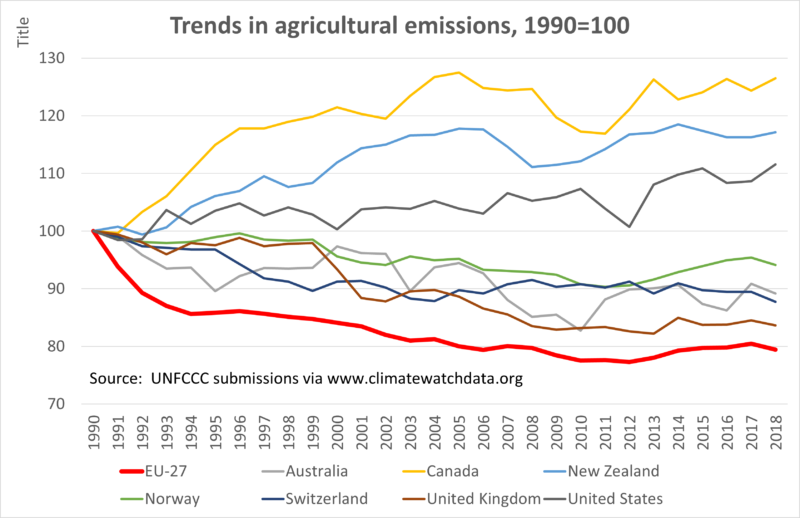
How have agricultural emissions trended during this period in the EU compared to other Annex 1 parties (developed countries) to the UNFCCC? The first chart below compares the trends in agricultural emissions (defined as mostly the non-CO2 gases emitted by agricultural production and soils) included in the national inventories submitted to the UNFCCC by selected Annex 1 countries.

Based on this evidence, agricultural emissions in the EU-27 have fallen by more over the period since 1990 than in the other Annex 1 countries shown.… Read the rest