



17 March 2026. This post is a revised version of the original post that takes account of some additional information as described in the post.
The likely size of the CAP budget in the next programming period 2028-2034 has been highly contentious since the publication of the Commission’s MFF proposal last July. Among agricultural stakeholders, the AGRI Committee in the Parliament, and the AGRIFISH Council, the amount available for the CAP under its two Pillars in the current programming period was compared with the size of the minimum ring-fenced amount for CAP income support in the proposal and found wanting. The Commission, on the other hand, has insisted on the potential for a larger CAP budget depending on the choices made by Member States. In its most recent Fact Sheet ‘Unlocking synergies integrating EU funding for farming and rural communities’ published in January 2026, it claims “the EU budget in support to farmers and rural communities for 2028-2034 can be at the same level or even higher than the current CAP allocation 2021-2027”.
I have written several blog posts exploring the different factors that will influence the size of the future CAP budget. In July 2025, I wrote a post comparing the NRPF allocations to each Member State with the pre-allocated amounts they received under the six shared management funds in the 2021-2027 MFF period that will be replaced by the ‘single fund’ to determine winners and losers from the new NRPF allocation formula (to be precise, the relevant comparison is between the NRPF General Allocation and the six shared management funds this replaces, as Home Affairs was treated differently).
I followed this with a post in September 2025 that highlighted the big budget picture in which the Commission proposed an ambitious MFF budget of almost €2 trillion euro, but carefully calibrated so that the overall funding for the shared management funds that would be merged into the ‘single fund’ was maintained in current prices. The General Allocation in the NRP Fund, which replaces the shared management funds but excludes Home Affairs, would even see a tiny increase relative to the current allocation.
When the Commission published the minimum ring-fenced CAP amounts for income support in September 2025, this then allowed me to examine the structural space for countries to top up their minimum amounts by allocating additional funds from the overall NRPF allocation considering also the other ring-fencing obligations for Member States. In a post in October 2025, my conclusion was that Member States would have very different possibilities to add to their minimum CAP amounts. For some Member States it was clear that they would be unable to maintain their CAP budget at the current 2021-2027 level, even if for some other countries there would be the financial scope to increase the CAP budget if this was the political will.
Then in January 2026 the Commission President announced a concession that would allow Member States to free up some the flexibility amount that would otherwise be unavailable for programming until the mid-term review of the national Plans, provided it was used for additional CAP interventions or measures dedicated to rural areas. The additional funding, which the Commission estimated at €45 billion, would increase the minimum CAP allocation by 15% or so if all Member States made use of this possibility. This makes a significant difference to the prospects for the CAP budget. In a post in January 2026 I estimated the likely increase in resources for the CAP for each Member State under this assumption.
This now provides the opportunity to redo the exercise in the October 2026 post taking account of these additional Mercosur amounts. In other words, we can ask about the structural space for countries to add to the Mercosur-amplified minimum ring-fenced CAP amounts from the non-allocated programmable resources to maintain CAP spending from Union funds in the next programming period at the same level in current prices as their pre-allocated amounts for the CAP in the current MFF period.
The overall NRPF budget
As a reminder, we start with Figure 1 which shows the size and share of the NRPF General Allocation in comparison to the overall MFF. The NRPF General Allocation equals the NRPF financial allocation for the NRP Plans less the minimum ring-fenced amount for Home Affairs. It merges the six shared management funds which are funded separately in the current CAP, including the two Pillars of the CAP, though it also has an additional objective to fund military mobility. We can thus make a direct comparison between the pre-allocated amounts for the six shared management funds and the General Allocation amount. Figure 1 shows that the Commission maintained the General Allocation amount at the same amount as previously allocated to the funds.
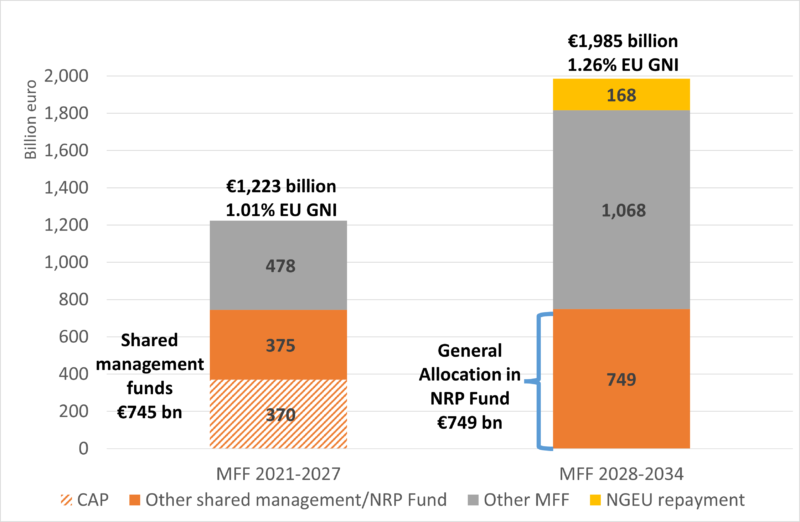
Source: See https://capreform.eu/how-big-will-the-cap-budget-be-in-the-next-mff/.
Member State NRPF allocations
That overall stability is not reflected in the NRPF allocations to individual Member States, due to the introduction of a new allocation key in Annex 1 of the NRPF Regulation. Figure 2 shows the percent changes in the NRPF General Allocation compared to the funding each Member State received for the six shared management funds it replaces in the current MFF. Countries to the left, including Czechia, Slovenia and Portugal, lose out under the new formula, while countries to the right of the graph, including some Central and European countries but also the Netherlands, Belgium and Luxembourg, gain.
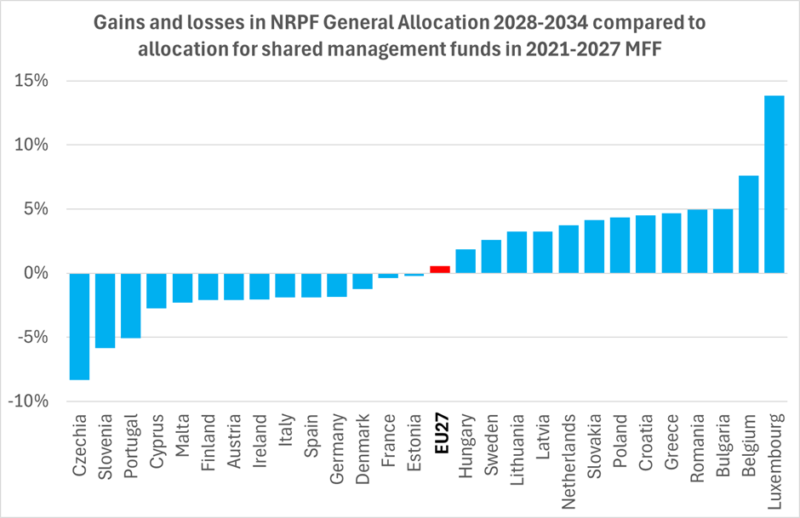
Source: See https://capreform.eu/which-countries-gain-or-lose-from-the-national-and-regional-partnership-fund/.
The structural scope to increase CAP spending beyond the minimum ring-fenced amount
The size of CAP spending within the NRPF allocations for each Member State will be determined by the amount of its NRPF allocation, its minimum ring-fenced amounts for CAP income support, and the amount of additional funds transferred from the non-ringfenced resources in the NRPF. The structural scope to increase the CAP budget in a Member State beyond the minimum amount is determined by several factors apart from its overall NRPF allocation. These include the minimum ring-fenced amounts for Home Affairs and fisheries in the Member State and the size of the flexibility amount (which is 25% of the NRP Plan financial allocation less the minimum amounts ring-fenced for CAP income support (less support for farm and forest investment) and fisheries and the minimum ring-fenced amount for Home Affairs). In addition, further constraints arise because of earmarking and spending targets for specific objectives.
Note that the exclusion of the minimum ring-fenced CAP and fisheries amounts from the calculation of the flexibility amount is explicitly mandated in Article 14(2) of the NRP Regulation. There is no such explicit provision for the exclusion of the Home Affairs minimum amount. However, the Commission estimate that the Mercosur amount will be €45 billion and not the €48.3 billion which I had previously calculated indicates that it intends also to exclude the Home Affairs amount. While the logic of excluding the minimum ring-fenced amounts from the calculation of the flexibility amount is clear, it will require an explicit amendment to the Regulation to take on board the Commission intention to also exclude Home Affairs. Despite this legal uncertainty, I have chosen to follow the Commission approach in the revised calculations presented here.
I assume that the minimum ring-fenced amounts for the CAP, fisheries and Home Affairs must be programmed when the Plans are approved – otherwise there is no guarantee that the legal minimum ring-fenced amounts will be spent. I also assume that the flexibility amount cannot be immediately programmed as it must be reserved, first, to fund compensation for natural disasters and then, at the Mid-Term Review, funds can be released for programming including to address new priorities and challenges that may have arisen since the approval of the national Plans.
However, we must factor in the concession made by the Commission in January in the context of seeking approval to sign the Mercosur agreement. This allows Member States to use up to the two-thirds of the flexibility amount set aside to be programmed at the Mid-Term Review immediately if allocated to CAP interventions or for measures dedicated to rural areas. For simplicity, I refer to these as the Mercosur amounts in the rest of this post.
In what follows, I assume that all Member States will use this flexibility, and that the unfrozen funds will be used for CAP interventions including investments in rural areas. But for this reason, I also assume that there will be no additional funds forthcoming for CAP interventions when the remainder of the flexibility amount is unfrozen later in the programming period. There is no legal hindrance to doing so, so this assumption is made to make the subsequent number-crunching easier.
When these Mercosur amounts are added to the minimum ring-fenced CAP amounts, then several Member States would already have a CAP budget larger than the amounts pre-allocated to CAP Pillars 1 and 2 in 2021-2027. We ask the question, how much extra would the other Member States have to add to these Mercosur-amplified amounts to maintain their CAP budget at the current level?
To get a sense of how constraining it will be for other Member States to find this money, we express the additional funding necessary as a percentage of the programmable NRP Fund resources that are not specifically allocated for other purposes at the beginning of the Plan period. These non-allocated programmable amounts are calculated as the total NRP Plan financial allocation to a member state, less the minimum ring-fenced amounts for CAP income support and fisheries, less the minimum ring-fenced amount for Home Affairs, and less the amount required to be reserved for the flexibility amount.
We can pause at this point to ask how the early mobilisation of the Mercosur amounts will impact on the size of the flexibility amount that cannot be immediately programmed. Article 14(2) of the NRPF Regulation reads: “A flexibility amount, corresponding to 25% of the Union financial contribution of a Member State as set out in Annex I [allocation method], shall only be available for programming as follows: (a) Up to one fifth may be requested by a Member State in accordance with Article 34 (Amendment of the plan in case of crisis situations), with the remaining amount to be programmed in accordance with Article 25 (mid-term review); (b) three fifths may be requested by a Member State in accordance with Article 25 [midterm review] of which a part may be requested before the mid-term review in duly justified and exceptional circumstances;….”.
Member States can now request to mobilise the Mercosur amounts out of the tranche set aside to be released as part of the mid-term review, so presumably this will fall under the “duly justified and exceptional circumstances” exception in Article 14. This, however, does not exempt Member States from the need to fulfil this obligation and to set aside the full flexibility amount at the outset of the Plan. We thus continue with the assumption that the full flexibility amount must be reserved at the outset of the Plan, even if the Mercosur amount will be available to add to the CAP budget at that point. This latter transfer does not release Member States from the requirement to show that they have met their obligation to establish the full 25% flexibility amount when designing their national Plans. In any event, adding the Mercosur amount to the CAP ring-fenced amount and substracting it from the unprogrammed flexibility amount would result in exactly the same outcome.
The outcome for Member States is shown in Figure 3. To the right are those countries where the Mercosur-amplified CAP amounts are already bigger than their current CAP receipts.
The blue bars show the percentages of the non-allocated programmable amounts that would have to be allocated in addition to the Mercosur-amplified CAP amounts to maintain CAP receipts at their current level in the other Member States. Countries that would be required to transfer, say, between zero and 40% of their non-allocated programmable amounts might find this relatively easy to do, whereas those countries that would have to transfer more than 40% will find this more difficult. In particular, Denmark, Ireland and Austria will hardly be able to maintain their CAP receipts given the configuration shown here.
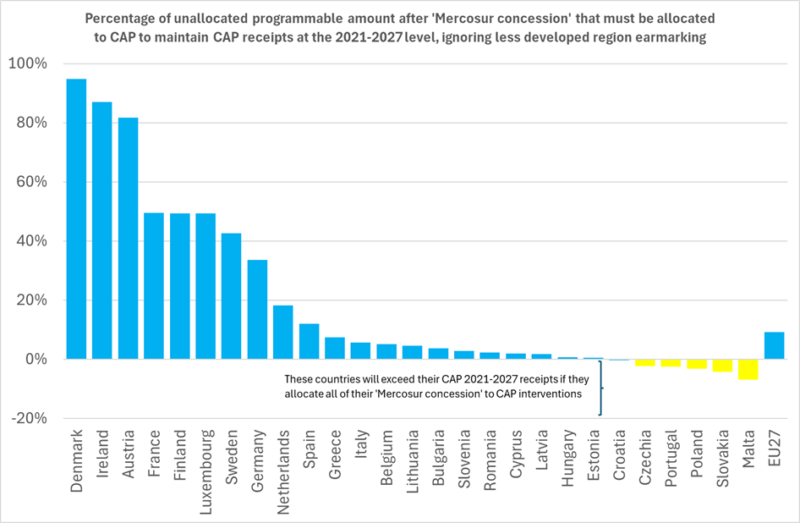
Note: In calculating the flexibility amount, I have not deducted the amount allocated to investment aids for farmers and foresters as this figure will not be known until the national Plans are drafted and approved. Taking account of this would slightly reduce the percentage amounts shown in this Figure.
Source: Calculations based on data in https://capreform.eu/further-reflections-on-cap-governance-and-budget/ and https://capreform.eu/potential-increase-in-cap-funding-in-next-mff/ revised as described in the text.
Less developed region earmarking
To this point, we have not taken into account the likely impact of the earmarking of specific amounts for less developed regions (LDR) and spending targets for social spending and climate and environment. Specifically, there are requirements for Member States with less developed regions to earmark specific allocated amounts for these regions. In addition, Member States are required to ensure that at least 14% of the NRPF allocation (including any loans funded by Catalyst Europe) should be earmarked for social purposes, and that at last 43% of the NRPF allocation (again including any loans funded by Catalyst Europe) should be earmarked for climate and environment spending.
In the previous iteration of this post, I had interpreted the allocation for less developed regions in specific Member States as a ring-fenced amount that would have to be financed in addition to the ring-fenced amounts for the CAP and Home Affairs. This was not correct. Specifically, for those Member States that have less developed regions, the amounts used for CAP and fisheries interventions beyond the ring-fenced amounts that are spent in these regions, as well as any Home Affairs spending undertaken in these regions, can be earmarked as contributing to the less developed regions spending target. CAP and fisheries ring-fenced spending is specifically excluded from counting towards LDR earmarking in Annex II of the NRPF Regulation.
The LDR earmarking creates mixed incentives for these Member States to allocate additional funds to the CAP. On the one hand, an investment measure undertaken in a less developed region counts 100% toward the spending target. If this funding were allocated to increase the CAP budget, then only the percentage share that would be spent in the less developed regions would count towards the target. Only if the CAP interventions financed from non-ringfenced resources would be primarily spent in less developed regions, such as aids for farming in areas of natural constraints, would the LDR earmarking encourage a transfer to the CAP budget. Member States might also explicitly limit certain interventions that are financed beyond the ringfenced amount , for example, investment aids or agri-environment-climate actions, to farmers in less developed regions.
The practical implication of the LDR earmarking for the structural ability of the affected Member States to transfer non-ringfenced resources to the CAP is thus uncertain. If Member States avail of the potential to transfer the Mercosur amounts from the flexibility amount either to the CAP or to measures dedicated to rural areas, some of this spending would likely count towards the less developed region spending target in those Member States with such regions. Nonetheless, on balance this LDR earmarking will likely be a structural impediment to releasing non-ringfenced amounts for the CAP in the relevant Member States. There will be a huge incentive for these Member States to make non-agricultural investments favoured by cohesion policy in these regions, particularly if these regions have a significant say in how the money allocated to them can be spent.
Social spending earmarking
Another binding constraint is the requirement that at least 14 % of the NRPF financial envelope as well as any loans under Catalyst Europe should be dedicated to meeting the Union’s social objectives (Art. 10(5)), calculated by using the coefficients set out for each intervention in the Performance Regulation. The minimum ring-fenced amount for the CAP is excluded from the basis for this calculation. But it is also the case that none of the CAP interventions listed in Annex 1 of the Performance Regulation (apart from expenditure on the School Scheme) would contribute to this spending target. This requirement will thus be a clear obstacle to Member States to transfer non-ringfenced resources to the CAP because this would make it more difficult for them to meet their social spending target.
Climate and environment targeting
There is a 35% contribution from the MFF budget set for the climate and biodiversity target, with separate targets for different programmes and instruments (Annex III of the Performance Regulation). For the NRP Plans, the spending target is set at 43%. Defence and security spending is excluded from the basis for the calculation of the climate and environment spending target. The contribution is calculated by using the highest coefficient amongst climate mitigation, climate adaptation and resilience, and environment of the budget expenditure tracking and performance framework. This may have a positive impact on the incentive for Member States to add to the CAP minimum ring-fenced amount.
Recall that it is not possible to add to the amounts used for the DABIS or coupled payments interventions, these can only be financed from the ring-fenced amount. Additional transfer for CAP expenditure could target agri-environment-climate actions, support to farmers in areas of natural constraints, investments, sectoral interventions, risk management measures, AKIS interventions, school schemes as well as integrated territorial tools (e.g. LEADER). Some of these measures, such as agri-environment-climate actions, risk management measures, green investments and support to farmers in mountain areas, attract a 100% coefficient. If countries have difficulty in reaching the 43% contribution spending target in other areas of spending, it could become attractive to transfer funds to specifically these CAP interventions in order to increase their spending contribution to the 43% minimum.
Rural targeting
The offer by Commission President von der Leyen to unfreeze some of the flexibility amount reserved for the Mid-Term Review in connection with approval of the Mercosur agreement also contained a second commitment. She also proposed that at least 10% of the resources of each NRP Plan would have to be dedicated to rural areas, excluding the ring-fenced amounts for the CAP and fisheries from the basis for this calculation. This can cover measures in rural areas that would not fall within the remit of the CAP to finance, but CAP measures beyond the ring-fenced amount would count towards this target. Additional text is proposed for inclusion in the NRPF Regulation to emphasise the importance of promoting integrated projects such as LEADER. In a previous blog post, I highlighted that it will not be easy to fully identify projects that are dedicated to rural areas. But, this caveat aside, this rural targeting will likely provide a positive incentive to Member States to add to their CAP budgets beyond the minimum amounts.
An alternative view of the structural scope to increase CAP spending beyond the CAP minimum ring-fenced amount
Figure 3 above showed the structural scope for countries to transfer non-allocated programmable amounts to top up the CAP minimum ring-fenced support taking into account the ring-fenced amounts for the CAP and Home Affairs, as well as the non-programmable flexibility amount. It did not take account of the earmarked amounts for less developed regions, nor the additional constraints imposed by the obligation to meet spending targets for social spending and climate and the environment.
We cannot say how severe these additional constraints might be before we see the composition of the draft national Plans. Purely as an illustrative exercise, we present in Figure 4 estimates of structural scope for adding to the CAP ring-fenced amount in each Member State, assuming that the earmarked amount for less developed regions is also a binding constraint. This is not a realistic assumption, but the exercise allows us to understand how additional constraints make it structurally more difficult to increase CAP budgets beyond the minimum amounts.
Assuming that the LDR minimum amounts are a binding constraint exaggerates its likely impact because, as noted earlier, some spending on CAP and fisheries interventions beyond the ring-fenced amounts as well as on Home Affairs will also contribute to the less developed region earmarking. For those Member States with less developed regions where the structural ability to transfer additional resources to the CAP is limited, the extent to which CAP spending will contribute to the LDR earmarking will also be limited. It is also unclear whether much of Home Affairs spending will take place in less developed regions. Further, assuming this maximalist position might also reflect the additional constraint arising from the social spending target where CAP spending makes no contribution (apart from the school scheme). For these reasons, this illustrative exercise can be informative. As not all Member States have less developed regions, the percentages shown in Figure 4 only differ for those MSs that have these regions.
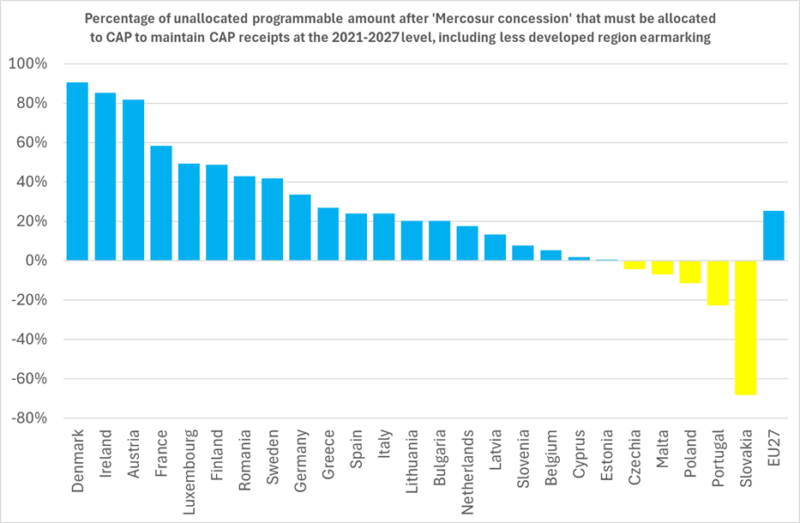
Source: As for Figure 3 with the LDR earmarked amounts taken from Annex 1 to the NPR Regulation.
Those countries that are shown in Figure 3 to be able to increase their CAP receipts compared to the 2021-2027 programming period by fully utilising their Mercosur amounts also do so in this scenario (apart from Croatia for reasons explained in a moment). The yellow bars are bigger in size because this increase in their CAP budgets is expressed relative to a smaller denominator (the non-allocated programmable amounts as the LDR earmarked amounts are now deducted in addition).
For the countries that will need to transfer additional amounts beyond the Mercosur amounts to maintain their CAP spending at 2021-2027 levels, there is no change in the percentage transfers for Denmark, Ireland and Austria as they have no less developed regions. But in general, assuming that the LDR earmarking might be an additional constraint would make it more difficult structurally to top up the CAP budgets (it would require a higher share of the non-allocated programmable amounts than was the case in Figure 3).
In the case of Croatia and Hungary, assuming that the LDR earmarked amounts are a binding constraint in addition to the ring-fenced amounts for the CAP and Home Affairs and the non-programmable flexibility amount makes the allocation problem infeasible. Their NRPF financial allocation would not be sufficient to fund all four constraints simultaneously. But this only reflects the unrealism of this assumption. In practice, the LDR earmarking constraint would be eased because some CAP and Home Affairs spending would be earmarked as also contributing to the LDR spending target. As we see in Figure 3, Croatia will be able to maintain its CAP receipts at the 2021-2027 level if it fully utilises its Mercosur amount for this purpose, while Hungary is extremely close to doing so (only requiring to transfer a further 1% from its non-allocated programmable NRPF amount).
Conclusions
The size of the CAP budget will not be known until the national Plans are drafted and approved. In this post I examine the structural constraints on the ability of Member States to add to their minimum CAP ring-fenced amounts to at least maintain their CAP receipts at the same level as in the current 2021-2027 period. It is also important to take account of the political constraints. Whether these amounts will be transferred or not will depend on the political priorities that shape the national Plans.
My analysis assumes that all Member States will utilise the concession announced by President von der Leyen to mobilise part of the frozen money in the flexibility amount at the beginning of the Plan period to be used for CAP interventions or dedicated to rural areas. I assume that all of this funding is used to finance CAP interventions including those in favour of rural areas. On the other side, I assume that no further transfers will be made to the CAP from the flexibility amount when resources are freed up at the mid-term review and later.
My assessment concurs with that of the Commission. Overall, the EU CAP budget will likely be similar to 2021-2027 in current prices and could even be greater. But the main message from the exercise is that there will be a different distribution across Member States. Denmark, Austria and Ireland will find it virtually impossible to maintain the same level of CAP receipts as under the current CAP. France, Luxembourg and Finland would need to transfer almost 50% of their non-allocated programmable resources but the political will may be there to do this. Other Member States would need to allocate around 40% or often much less of their non-allocated programmable resources to maintain their CAP receipts, and there are six Member States that will exceed their CAP budget in 2021-2027 assuming they are willing to transfer in full the Mercosur amount to the CAP.
There is, of course, a very major caveat to this conclusion. This analysis is based on the Commission MFF proposal. It will remain valid only if the Council and Parliament keep the MFF budget at its proposed size. If the MFF budget is reduced, as must be deemed likely, the CAP budget will be also.
This post was written by Alan Matthews.
Photo credit: Images Money downloaded from Flickr and used under a CC by 2.0 licence.
