


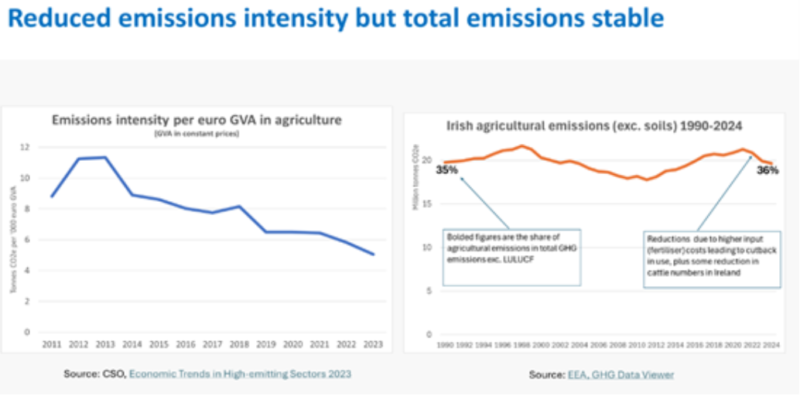
Two weeks ago, I had the pleasure of giving an invited talk at the Irish Environmental Protection Agency’s annual Climate Change Conference 2026 in Dublin. My topic was “Incentivising climate action in the agriculture and land use sectors”. Irish agriculture has shown a steady improvement in emissions intensity, but almost no reduction in absolute emissions since 1990. As it accounts for 36% of emissions in the national inventory (excluding energy use and soil emissions), there is an urgent need to adopt lower-emission technologies and to shift to lower-emission land uses at scale.
The key issue I raise is, if we want lower-emissions agriculture and land use in Ireland, then how do we make lower-emissions land use economically viable at farm level? And how do we incentivise that change? Land use systems do not change simply because alternative systems appear environmentally desirable. They change when there are viable markets, reliable income streams, manageable risks, functioning supply chains, and credible long-term incentives.
All the conference interventions are available on YouTube at the following link https://www.youtube.com/playlist?list=PLFesobjWT1FgjMDcelfET3rbWja1ub2Td. My own intervention (just under 17 minutes) can be viewed at https://www.youtube.com/watch?v=pJTf_tz8670&list=PLFesobjWT1FgjMDcelfET3rbWja1ub2Td&index=7. For those who prefer reading to listening, I have included the transcript of my remarks in this blog post.
Transcript of talk
I am grateful for this opportunity to contribute to this panel on the topic of incentivising climate action in Irish agriculture and land use.
Six propositions form the backdrop to my presentation.
First, the Irish agri-food sector is economically and socially important. It is one of Ireland’s major indigenous sectors, a major export earner, and central to the economic and social fabric of many rural regions.
Second, Irish agriculture is unusual in European terms because of the scale of its greenhouse gas emissions contribution. Agriculture accounts for around 36 per cent of Ireland’s territorial greenhouse gas emissions, largely because of the dominant role of ruminant livestock in our production system.
Third, despite considerable progress in emissions efficiency, current trajectories are not consistent with either Ireland’s national climate targets or future EU obligations. Irish agriculture has become more emissions-efficient over time, but aggregate emissions have not fallen.
Fourth, failure to close those gaps may expose Ireland to very significant fiscal costs through compliance mechanisms at EU level. Climate action is no longer simply an environmental issue. It increasingly carries potentially very large fiscal consequences for the Irish State and ultimately for taxpayers.
Fifth, climate change is also increasingly an adaptation challenge for Irish agriculture. Climate change is real, accelerating, and already affecting agriculture through changing rainfall patterns and more frequent weather extremes. Climate policy therefore needs to support both emissions reduction and resilience.
Sixth, the socio-economic conditions for rapid transition are difficult on many Irish farms. Farm incomes and financial surpluses remain modest across large parts of the sector. 2024 was a record high for the proportion of economically viable cattle and sheep farms, defined as returning the minimum wage for labour plus a 5% return on non-land assets. Yet in that year only 30% of cattle farms and 41% of sheep farms were classified as viable. In that year, direct payments accounted for 129% of the family farm income on cattle rearing farms, and 102% of the family farm income on sheep farms, although in both cases the majority of these direct payments came from environmental schemes and ANC payments rather than pure area-based payments. The farming population is ageing, with the average farmer now close to 60 years of age and farm succession uncertain on many holdings.
Two competing narratives and my central message
Although these points would be broadly accepted, public discussion often proceeds through two competing narratives.
One narrative argues that Irish agriculture is already among the most carbon efficient in the world, that continued production growth is compatible with climate action, and that technology will largely solve the emissions problem without major structural adjustment.
The second narrative argues that Ireland must reduce livestock numbers substantially and move towards different land use systems, with a stronger emphasis on tillage, horticulture, forestry, peatland restoration, or agroecological production systems.
Both narratives contain elements of truth, but both are incomplete.
We need to encourage and promote the development of technical mitigation options, but the first narrative underestimates the scale of adjustment required. Even with improvements in emissions intensity, absolute agricultural emissions remain high. Efficiency improvements alone will not close the emissions gap.
Futthermore, climate policy does not sit alone. As a country, we also have an objective to restore nature through the EU Nature Restoration Law, and to restore all water bodies to good ecological status under the Water Framework Directive. There are obvious synergies between climate, nature and water policies that we should exploit.
If the first narrative underestimates the scale of adjustment likely to be required, the second narrative underestimates the economic and social realities of farming. Simply demanding transition without economically credible alternatives is unlikely to generate large-scale change.
Land use systems do not change simply because alternative systems appear environmentally desirable. They change when there are viable markets, reliable income streams, manageable risks, functioning supply chains, and credible long-term incentives.
And that, I think, is where climate policy in Irish agriculture now needs to focus much more seriously.
If we want lower-emissions agriculture and land use in Ireland, then the central policy question becomes: how do we make lower-emissions land use economically viable at farm level?
And how do we incentivise that change?
What Has Been Tried So Far?
The current Irish approach, reflected in the Climate Action Plan 2025, relies overwhelmingly on voluntary actions incentivised through subsidy and support schemes. These measures focus on reducing emissions intensity within existing production systems, such as improved breeding, protected urea, low-emissions slurry spreading, feed additives, better animal health, and improved nutrient management.
A second strand increasingly focuses on land use change and diversification. Measures now include peatland restoration, afforestation, organics, extensification, renewable energy generation, biomethane production, carbon farming initiatives, and greater emphasis on nature restoration.
There has clearly been progress. Participation in environmental schemes has expanded significantly. Farmers have shown willingness to adopt measures that are relatively low risk, technically straightforward, and compatible with existing systems.
But there are also clear limitations.
Many measures produce only modest emissions reductions individually. The cumulative impact still falls short of what is required.
What Needs to Change?
If we are serious about transition, the policy question is not simply how to subsidise individual actions. It is how to create economically durable lower-emission farming systems.
This involves four dimensions that should be pursued in tandem.
Develop credible alternative income streams
First, we need to create credible long-term income streams for lower-emissions land use. Some opportunities already exist. Forestry and peatland restoration provide one route. In many cases, forestry can already outcompete low-return drystock farming financially, particularly once premia are included. But both forestry and peatland management remain politically and culturally contested, and many farmers remain wary of long-term land use change because of concerns around permanence, regulation and loss of farming identity.
Renewable energy is another alternative enterprise. Wind and solar projects are already becoming significant supplementary income sources on some farms. Biomethane and anaerobic digestion may also contribute in certain circumstances, although the economics remain highly dependent on public support and feedstock availability. These are not complete solutions, and they raise difficult questions around landscape, community acceptance and the most efficient use of land. But they do demonstrate an important principle: climate-friendly land use must also be economically viable land use.
There is also some scope for diversification towards more lower-emission forms of food production, including horticulture and some tillage systems. But here again we should avoid romanticising the alternatives. Horticulture generates much higher employment per hectare than grazing systems, but precisely for that reason it faces major labour constraints, and the sector already struggles with labour availability and rising wage costs. Large-scale expansion would likely require either much greater migrant labour availability or substantial capital investment in automation.
Carbon farming may become more important over time, particularly for peatlands, forestry and soil management. But I remain cautious about how large this opportunity really is. The future demand for carbon credits remains uncertain, transaction and verification costs are high, and many farmers may find the administrative burden disproportionate to the likely returns.
Some of these measures may prove attractive because they also improve resilience to climate shocks. Greater soil organic matter, more diverse swards, restored peatlands, hedgerows, agroforestry, and lower input dependency can potentially improve water retention, reduce vulnerability to fertiliser and energy price shocks, and strengthen resilience to more variable weather conditions.
There is no single alternative enterprise waiting to replace Irish livestock farming. The transition is more likely to involve a patchwork of different income streams, land uses and production systems depending on region and farm type. But the broader point remains. If lower-emission land uses remain economically marginal or administratively uncertain, then adoption at scale is unlikely.
Transition infrastructure
This brings us to the importance of what might be called “transition infrastructure”. Transition infrastructure refers to the enabling systems that make lower-emissions land use economically and institutionally viable. It includes processing capacity, advisory systems, financing mechanisms, data systems, market organisation, contractual arrangements, logistics, and regulatory frameworks. In effect, it is the set of institutions and investments that allow farmers to move from one production model to another without bearing excessive individual risk.
Many lower-emissions alternatives remain institutionally underdeveloped. Even where technical alternatives exist, the surrounding infrastructure often does not. This creates an important asymmetry. Existing livestock systems benefit from mature supply chains, established processing industries, advisory support, export markets, and relatively predictable commercial arrangements. By contrast, alternative land uses frequently involve uncertain revenues, weak value chains, limited advisory support, and unclear long-term policy commitment.
That is why transition infrastructure becomes central to climate action. Emissions reduction in agriculture is not simply a matter of persuading individual farmers to behave differently. It requires building the institutional and economic conditions within which different forms of land use become practical and commercially credible.
Ireland requires a more explicit industrial strategy for lower-emissions land use. If diversification into horticulture, forestry products, biomaterials, biomethane, carbon farming, or ecosystem services is desired, then the associated processing, logistics, market, financing, advisory and research infrastructure must also be developed. Without transition infrastructure, farmers are effectively being asked to change production systems before viable markets exist.
Redesign incentives
Third, we need to redesign incentives.
There is scope to use CAP payments more strategically to reward public goods provision, carbon sequestration, biodiversity management, and lower-emission production systems. That does not mean reducing farm income support overall, but it does imply changing the basis on which support is allocated. CAP and national payments continue in many cases to support land occupation and livestock-linked systems more strongly than climate performance.
There is a strong argument for phasing out perverse incentives that favour emissions-intensive activity. Schemes such as the Suckler Carbon Efficiency Programme and the Beef Welfare Scheme and similar schemes for sheep effectively provide support to livestock farming, although the role of payments in maintaining low-density grazing in upland areas to manage wildfire risk should be recognised. CAP payments are also made for farming on drained peat soils when they should instead pay farmers for restoring these soils. Climate policy becomes much harder when one part of the policy system encourages expansion while another attempts to subsidise mitigation.
Price emissions
Fourth, we need to talk about pricing emissions.
Its central economic function is to create a price signal that changes relative incentives within the sector. Emissions-intensive systems become relatively less attractive, while lower-emission technologies and production systems become more competitive.
This matters because relying on subsidies alone has important limitations. Grants and voluntary schemes can support adoption of particular practices, but they do not fundamentally alter underlying production incentives and often lack clear measurable emissions outcomes. Where schemes pursue multiple objectives simultaneously, climate effectiveness can also become diluted. Subsidy-based approaches are additionally vulnerable to deadweight losses, behavioural resistance, and rebound effects where efficiency gains support continued production expansion. Nor do they create a strong market for innovation in emissions reduction technologies. If emissions remain economically invisible, there is limited commercial incentive to develop methane-reducing feed additives, precision nutrient technologies, manure treatment systems, or alternative land uses. Pricing helps create that market.
Designing a pricing scheme must address three main concerns.
The first is that emissions pricing would impose excessive adjustment pressure on farmers. But this depends heavily on policy design. The Danish model is important precisely because it combines a meaningful marginal carbon price with a substantial rebate mechanism, currently proposed at around 60 percent, alongside significant transition supports, investment funding and the recycling of revenue proceeds back to farming. This protects short-run farm liquidity while providing a strong incentive to reduce emissions.
A second concern is administrative complexity. Agricultural emissions are certainly harder to measure than fossil fuel emissions because they arise from diffuse biological processes. But many farmers are already using carbon budgeting and sustainability assessment tools through advisory systems, processors, and assurance schemes. Agricultural policy already relies extensively on modelling, nutrient accounting, and farm-level reporting systems. The issue is therefore better understood as one of institutional development and system design rather than an insurmountable obstacle.
A third concern is carbon leakage: that reducing Irish production would simply shift production and emissions elsewhere. Leakage risks are real, but they depend on market responses, trade structures, productivity differences, and international policy coordination. They are not an argument against domestic mitigation altogether. Moreover, international food markets are increasingly moving toward carbon accountability across supply chains and trade systems. Processors, retailers, financial institutions, and importing jurisdictions are beginning to differentiate producers on the basis of emissions performance. In that context, failure to adapt may itself create competitiveness risks over time.
The relevant question is therefore not whether agricultural emissions should face stronger economic signals, but how such systems can be designed carefully and credibly in ways that support both emissions reduction and economically viable rural transition.
Conclusion
Let me conclude with three final observations.
First, climate transition in Irish agriculture is not simply a technical problem. It is fundamentally an economic and political transition problem.
Second, the central challenge is credibility. Farmers must believe that lower-emission pathways can support stable and dignified livelihoods over the long term. Without that belief, policy will continue to encounter resistance, delay, and partial implementation.
Third, successful transition requires moving beyond a narrow debate between defending the status quo and demanding immediate contraction. The more constructive question is how to build economically viable rural systems compatible with climate objectives.
That means investing in transition infrastructure. It means redesigning incentives. It means supporting new income models. And it also means, over time, integrating clearer carbon pricing signals into the system.
This post was written by Alan Matthews.
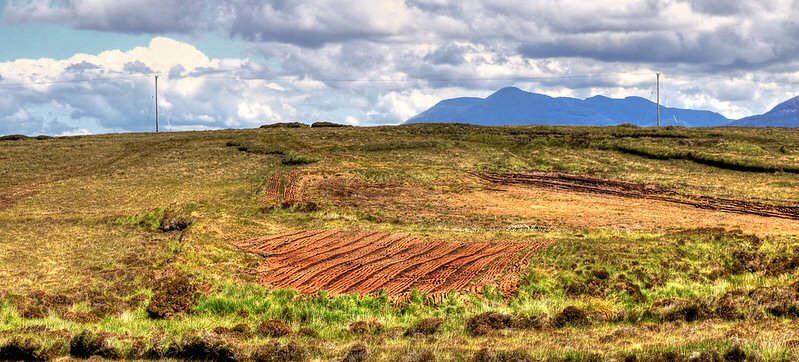
Photo credit: Daniel Mennerich Peat bog in Connemara, via Flickr and used under a CC BY-NC-SA 2.0 licence
